MakarovSuites
English
EnglishDeutschРусскийУкраїнськаFrançaisEspañolItalianoPolski
Contact & licences

Engineering

Tunnel boring machine

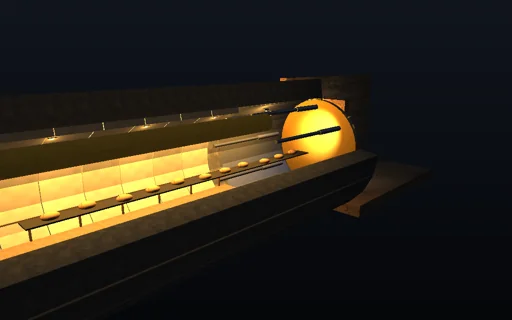
Bore a six-metre tunnel through sandstone, granite, a fault zone and limestone by the light of the crown lamps. Forty disc cutters each carry the load the Colorado School of Mines model gives for the rock’s strength and the penetration per turn; the thrust you set, less the shield’s friction, decides how deep they cut - unless the head’s torque, the cutter rating or the machine’s penetration cap binds first. Bore a stroke, stop and build a lining ring, stop again when the outer cutters, which roll farthest, are worn out; compare advance rates and specific energies in each rock, and give the machine full thrust in granite to see the drive run out of torque.
Tunnel boring machine — Actual application image
Actual application image

What happens

A 6 m head with forty 17-inch disc cutters at radii R·sqrt((i + ½)/40). Each cutter carries the Colorado School of Mines force C·T·R·phi·(S·sigma_c²·sigma_t/(phi·sqrt(R·T)))^(1/3) at the contact angle acos((R − p)/R); the penetration per turn solves the thrust balance with the shield’s friction, then is cut back to the cutter rating and to the torque the drive can give at its speed. Rock changes along the drive: sandstone, granite, a fault zone, limestone. Each cutter’s ring wears with the distance it rolls and the rock’s abrasivity; the machine bores one 1.8 m stroke, stops to erect a ring, and stops again to change worn cutters. Quasi-static steps of 1 s.

Try this

Watch the advance rate and the limit change with the rock; give full thrust in granite to run out of torque; shorten the wear limit; read the specific energy of each rock.

The model and its limits

A quasi-static cutting law for one cutter spacing, uniform rock in each layer, no face collapse, no muck handling limits, a fixed ring-building time. Advance rates are those of this idealized machine.

Equations used in the module
Equations
F_t = C·T·R·φ·(S·σ_c²·σ_t/(φ·√(R·T)))^(1/3),  φ = acos((R − p)/R)
N·F_t·cos(φ/2) + F_shield = F_thrust,  M = F_t·sin(φ/2)·Σ r_i
p = min(p_thrust, p_cutter, p_torque, p_max),  v = p·n
dw_i/dt = k_w·CAI·2π·r_i·n,  E_s = M·ω/(π·R²·v)

Related experiments

Back to catalogue
Clockwork drawing automaton — Actual application image

Engineering

Clockwork drawing automaton

By candlelight in an eighteenth-century salon a clockwork boy draws with a quill. A mainspring, its torque falling as it unwinds, turns the program shaft, and a two-vane fly governs the speed by its air drag, so a drawing takes the closed-form time. Three cams cut from the drawing - Fourier series of the arm’s inverse kinematics - move the shoulder, the elbow and the pen lift through their followers and levers, and the ink line is the image of the cam profiles. Choose a circle, a figure of eight, a flower, a star or a ship; give the cams fewer harmonics and the corners round off; fold the fly’s vanes until the followers fly off their cams above the closed-form lift-off speed and the star is distorted; set the pen-lift cam late or lift too little and the connecting lines appear. Every joule of the spring is followed into the fly, the bearing, the contacts and the stop.

Wall-climbing robot — Actual application image

Engineering

Wall-climbing robot

Send a window-cleaning robot up the glass facade of an office tower at bright noon, high above the city: two impellers evacuate its chambers until each fan curve meets the leakage under the skirt at a closed-form 2.7 kPa, and the suction presses its wheels to the glass. It holds while mu ΔP A outweighs its weight, and it does not peel while the moment of the suction about the lower wheels beats the overturning moment of its weight. Watch the pressure dip each time a lip slides over a silicone joint: with sound joints it climbs on, with open ones the wheels slip and it stops at the closed-form stall point. Load the water tank until the motors crawl, switch off a chamber or send a gust, and the rope grab on the safety line catches it; the work of the motors is followed into height, lip drag, slip and the rope.