Math
Basins of Newton's method
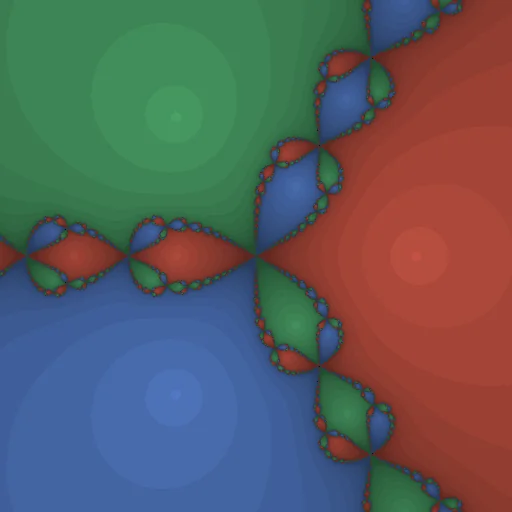
Colour every starting point by the root Newton's method reaches: with two roots the boundary is a straight line, as Cayley proved in 1879, and with three it is a fractal that all three basins share. Drag a root and watch the areas move - a root pulled outward takes LESS of the window, not more.
What happens
Newton's method: start anywhere, step z to z minus p(z)/p'(z), repeat, and you fall into one of the roots. Colour every starting point by the root it reaches and the plane divides into basins. With TWO roots the picture is dull, and Cayley proved it in 1879: the boundary is the perpendicular bisector of the segment joining them, a straight line and nothing else - on a 600 x 600 grid not one point lands on the wrong side. With THREE roots Cayley failed, and it took a century to see why. The boundary is a fractal, and the three basins do not meet pairwise along fences: they share ONE boundary. That is measurable. Count the boundary cells that see all three colours at once, and the share sits at about 0.60 and STAYS there as the grid is refined from 300 to 900 - if the basins met pairwise along ordinary curves, a cell seeing every colour could only sit near an isolated triple point and its share would fall like 1/n. It does not fall. The areas are worth watching too: over a disk, which shares the roots' 120-degree symmetry, each basin takes exactly a third; over the square window it does not, because the corners belong to whichever root points at them, and that is the window's doing rather than the method's. Drag a root outward and its own basin SHRINKS - the opposite of the natural guess. The dark threads are where the method fails outright: at the origin the derivative vanishes and there is no step to take.
Equations used in the module
Equations
Newton:  z ← z − a·p(z)/p′(z),  p(z) = product of (z − r_i);  a = 1 is Newton, and near a simple root the error multiplies by |1 − a| per step
two roots (Cayley 1879):  the boundary is the perpendicular bisector of the segment joining them - a straight line;  600 × 600 grid, 0 points on the wrong side, 0 unsettled
three roots:  the boundary is a fractal shared by ALL the basins (Wada);  boundary cells seeing all three colours: 0.6194 at 300², 0.5959 at 600², 0.5972 at 900² - flat, where pairwise borders would fall like 1/n
areas:  over a DISK (which shares the 120° symmetry) 0.3333 each;  over the square 0.3531 / 0.3234 / 0.3234 - the corners, not the method
dragging:  a root pulled out to 1.8 takes 0.1819 of the window while the two left behind take 0.4091 each - outward means LESS
box dimension of the boundary:  ≈ 1.50 measured on a 900² grid over [−2, 2]², per-box estimates 1.53 … 1.58
iterations:  mean 6.84, worst 38, 8 points of 160 000 never settle;  at the origin p′ = 4.7e-16 and the step is undefined
relaxation:  a = 0.5 → 632 unsettled of 90 000;  a = 1 → 0;  a = 1.5 → 200;  a = 2 → all 90 000, the marginal case |1 − a| = 1