Math
Centres of a triangle and the Euler line
Click the paper to predict a centre. Reveal one line at a time, then drag the brass vertex pins. Try the obtuse preset: which centres leave the triangle?
What happens
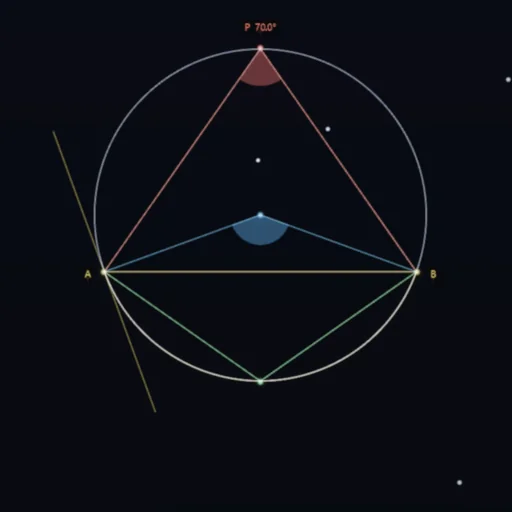
Click the paper to predict a centre. Reveal one line at a time, then drag the brass vertex pins. Try the obtuse preset: which centres leave the triangle? The drawing stays square-on with equal axis scales. Pause freezes construction, traces and the ratio chart; vertices remain editable. Enable a trace or press Start to record motion. Traces fade after 8 simulation seconds and are not the current Euler line.
Equations used in the module
Equations
centres:  G = (A + B + C)/3;  O the intersection of the perpendicular bisectors;  H = A + B + C − 2O;  I = (aA + bB + cC)/(a + b + c);  N = (O + H)/2
Euler line:  G, O, H collinear with OG : GH = 1 : 2;  |OH|² = 9R² − (a² + b² + c²)
nine-point circle:  centre N, radius R/2, through the three midpoints of the sides, the three feet of the altitudes and the three midpoints of AH, BH, CH
Feuerbach:  the nine-point circle touches the incircle from outside, |NI| = R/2 − r
Euler's formula:  |OI|² = R(R − 2r), hence R ≥ 2r, with equality exactly for the equilateral triangle, where G = O = H = I = N
measured here:  sin of the angle between OG and OH (0 to 1e-16), GH/OG (2.000000), the nine distances to N (R/2 to 1e-16), |NI| − (R/2 − r) (1e-16) - all pinned against the Python twin