Math
Inversion: circles into lines
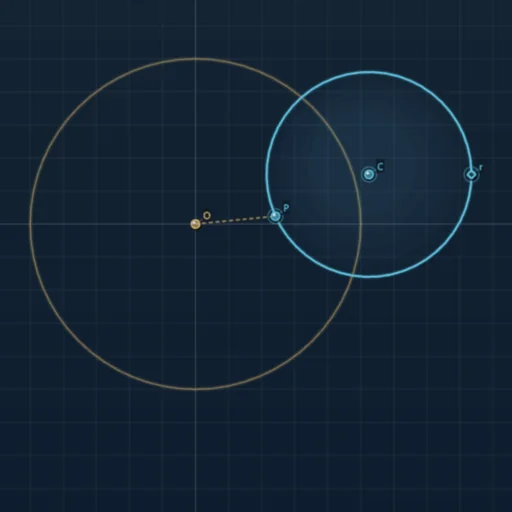
Drag C to move the circle, the diamond r to resize it, or P along its rim. Take the circle through O and compare its image. The brass ring has R = 1; points on it stay fixed. Adjust ρ until the last circle touches the first after one turn. The same numbered circles correspond across the two views. Start lets the chain slide; a closed chain stays closed.
What happens
Drag C to move the circle, the diamond r to resize it, or P along its rim. Take the circle through O and compare its image. The brass ring has R = 1; points on it stay fixed. Move A or B until the circles meet. Tangents and their images show the same angle with reversed orientation. Both drawings keep equal horizontal and vertical scales. Adjust ρ until the last circle touches the first after one turn. The same numbered circles correspond across the two views. Start lets the chain slide; a closed chain stays closed. Inversion maps points on the same ray: OP·OP′ = R². Away from O it preserves angle magnitudes and reverses orientation. Lengths and circle centres generally do not survive the map.
Equations used in the module
Equations
I(P) = P/|P|²; R = 1; OP·OP′ = 1; I(I(P)) = P, P ≠ O
q = |c|² − r²; q ≠ 0: C′ = c/q, r′ = r/|q|; I(c) ≠ C′ (r > 0, c ≠ O)
q = 0: 2c·X = 1; d(O, line) = 1/(2|c|); O → ∞
DI(P)v = (v − 2P(P·v)/|P|²)/|P|²; α′ = −α; Δα = |α + α′|
Steiner: r = (ρ−1)/2; Δφ = 2π − 2n·arcsin((ρ−1)/(ρ+1))
Δφ = 0: ρ = (1 + sin(π/n))/(1 − sin(π/n)); n = 3…12