Math
Ceva and Menelaus
Slide three coloured ratios to make the cevians meet or the feet line up. Explore signed segments, hints, medians and the parallel exception.
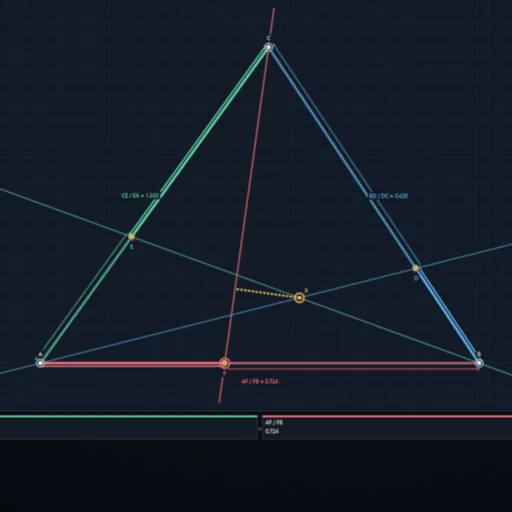
What happens
Drag D, E or F until all three cevians meet at X. Aim for +1 and a small geometric miss. Drag D, E or F until the feet share one line. Aim for −1 and a small geometric miss. The arrows follow B→D→C, C→E→A, A→F→B. Between the vertices both segments have the same direction: a positive ratio. On an extension the directions oppose: a negative ratio. For a nondegenerate triangle and feet away from vertices: product +1 means concurrent OR parallel cevians; product −1 means collinear feet. Menelaus allows one or three external feet. A numerical check is not a proof. Drag the brass grips along side lines; drag A, B or C to reshape the triangle. Right drag pans; the wheel zooms. Pause stops automatic movement. Slider range: −3 ≤ t ≤ 4. Click the numeric value to type an exact position.
Equations used in the module
Equations
A, B, C non-collinear; D,E,F distinct from the vertices
D = B + tD(C−B); E = C + tE(A−C); F = A + tF(B−A)
rD = BD/DC = tD/(1−tD); rE = CE/EA; rF = AF/FB
Ceva: rD·rE·rF = +1 ⇔ AD,BE,CF concurrent OR parallel
Menelaus: rD·rE·rF = −1 ⇔ D,E,F collinear
0 < t < 1 ⇒ r > 0; t < 0 or t > 1 ⇒ r < 0; t = 1 ⇒ undefined
rRequired = target / (rOther1·rOther2); tRequired = rRequired/(1+rRequired)
rRequired = −1 ⇒ no finite foot; t = 0,1 excluded by both theorems
Ceva miss = distance(X,CF) / longest side; X = AD ∩ BE, when finite
Menelaus miss = distance(F,DE) / longest side
Task tolerance: |product−target| < 0.005 AND relative miss < 0.002