Engineering
Compound planetary gearbox
Shift a two-set planetary gearbox through first, second, third and reverse under a light and a heavy load; each gear is just a pair of clutches and brakes. Then apply both brakes at once and watch the box lock up.
What happens
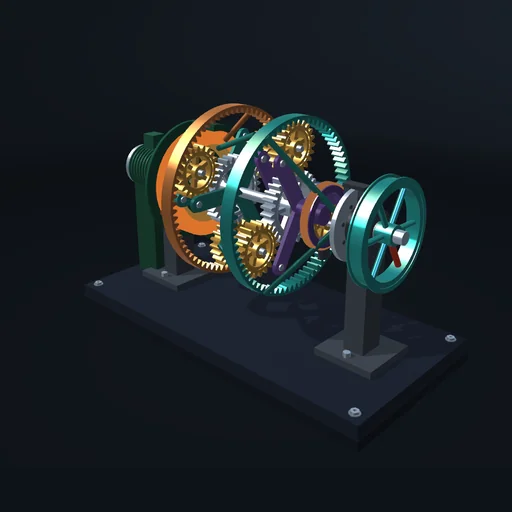
A three-speed Simpson gearbox, as in classic automatic transmissions: two planetary sets on one common sun of 30 teeth, with rings of 72, the front carrier joined to the rear ring as the output. Two clutches join the input to the front ring (C1) or to the sun (C2); two brakes hold the sun (B1) or the rear carrier (B2). A gear is nothing but a pair of applied elements: first C1 + B2 (ratio 0.414), second C1 + B1 (0.706), third C1 + C2 (direct drive, 1), reverse C2 + B2 (−0.417). Each pair leaves the five members exactly one free motion, and the input drives it. A shift releases one element and applies another over the shift time: they slip, heat up and dip the output torque, the more so under a heavy load. In first gear, apply B1 as well: with C1, B1 and B2 no motion is left for the input, and the box ties up – the motor stalls against the brakes.
Model: rigid gears on their own bearings; the meshes are frictionless contacts along the line of action; clutches and brakes are friction couplings whose capacity ramps linearly over the shift time. No hydraulics, torque converter or shift strategy; the slip heat is counted, not stored.
Try this
Shift up through first, second and third under a light load, then under a heavy one, and compare the slip heat. Then apply B1 in first gear.
Equations used in the module
Equations
zs ωs + zr ωr = (zs + zr) ωc
I:  C1 + B2,  ωo/ωi = 0.414
II:  C1 + B1,  ωo/ωi = 0.706
III:  C1 + C2,  ωo/ωi = 1
R:  C2 + B2,  ωo/ωi = −0.417