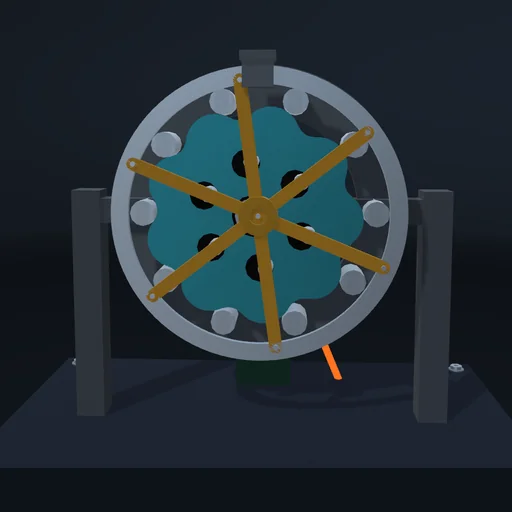
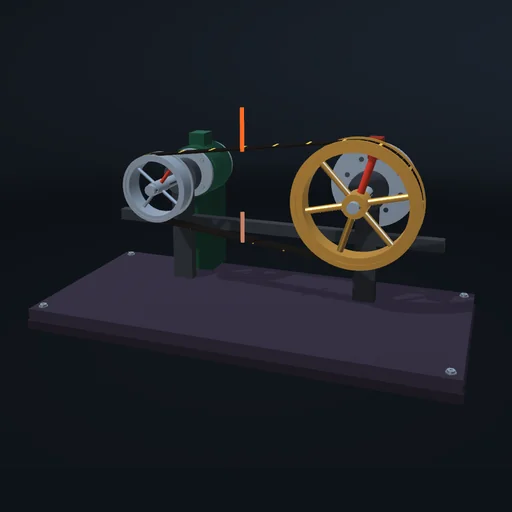
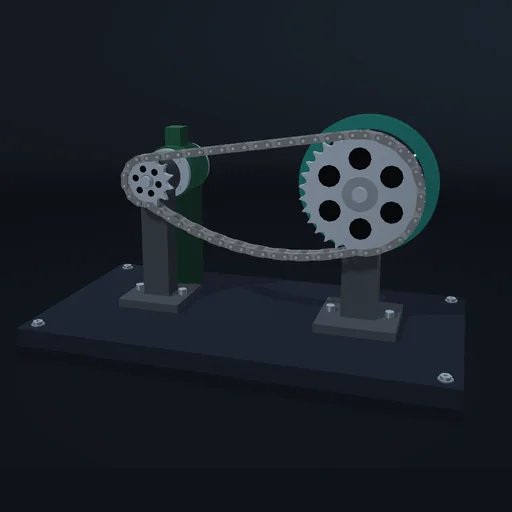
Engineering
Strain-wave gear
Wind a spring through a strain-wave gear and watch the elastic cup wind up by T/K; reverse and the spring gives its energy back. Compare two and three lobes, 60 and 120 teeth: the reduction is the flexspline’s teeth over the tooth difference.
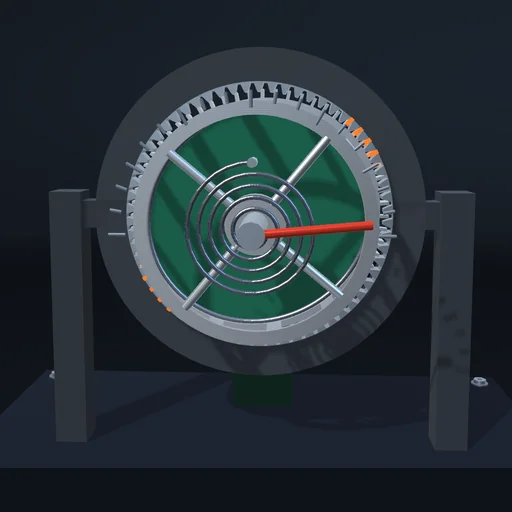
What happens
A strain-wave (harmonic) gear: a lobed wave generator on the input shaft bends a thin flexspline cup so that its outer teeth engage the fixed circular spline only at the lobes. The flexspline has as many teeth fewer as there are lobes, and for every turn of the generator it falls behind by that difference: the reduction is N = zf/Δz – 30 or 20 with 60 teeth and two or three lobes, 60 or 40 with 120. The output turns backwards. The cup is torsionally elastic: under the torque T of the spring on the output it winds up by T/K, some minutes of arc. Wind the spring, and the output lags the rigid gear by exactly that. Reverse: the spring drives the gear back and returns its energy, less the small drag of the generator’s bearing. The glowing teeth mark the engagement zones, which walk round with the generator.
Model: the gear is a rotation coupling of ratio −1/N with torsional stiffness K and a little damping; the bearings drag with a constant torque. The drawn bending of the flexspline shows the kinematics; tooth contact, stresses and the nonlinear stiffness of real cups are not computed.
Try this
Wind the spring and read the wind-up; reverse and let it unwind. Then compare the designs.
Equations used in the module
Equations
N = zf/(zc − zf) = zf/Δz
θo = −θi/N
Δθ = T/K,  E = ½ K Δθ²
Ti = T/N + Td