Engineering
Conveyor sorting station
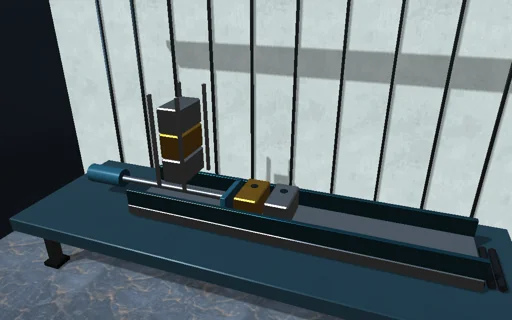
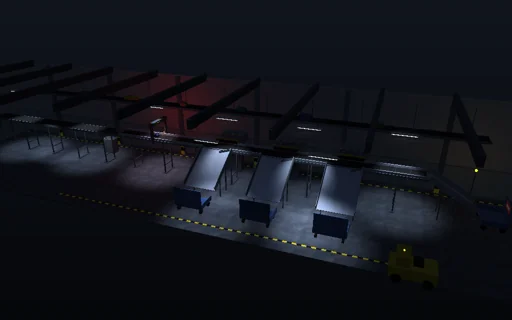
Run an airport baggage hall on the night shift. Duffels, hard-shell cases, backpacks, heavy cases and golf bags wait on the induction belt until the gap control releases them; each slips on the main belt at mu g until it runs at belt speed, V/(mu g) later. Under the red laser of the scanner arch a photo-eye times the bag, and the controller fires the pusher of its chute at the computed instant: the paddle drives it sideways against the Coulomb friction of the belt, mu m g, while the belt carries it on, and it slides down a steel chute to its cart at the closed-form speed. Flood the line and the queue grows at the closed-form capacity; close the gap and bags crash into pushers still across the belt; weaken the pusher below mu m g and heavy cases do not move at all; add latency and the long golf bags miss until the eye setting moves by V tau.
What happens
A 20 m belt, 1 m wide, runs at 1.5 m/s. Five kinds of bag - duffel 14 kg (mu 0.55 on the belt, 0.33 on steel), hard-shell case 20 kg (0.30/0.18), backpack 9 kg (0.60/0.35), heavy case 32 kg (0.38/0.20), golf bag 15 kg, 1.2 m long (0.45/0.28) - arrive at 30 a minute and wait on the induction belt; a bag is released at rest once the one before is 1.2 m clear, slips at mu g for V/(mu g) and runs with the belt, so the gap control passes (gap + L)/V + V/(2 mu g) per bag: 40 a minute for the mix. A photo-eye at 3 m times the front and rear edges; the controller fires the pusher of the bag’s chute when the centre is predicted 0.3 m before the paddle, after the latency, from the configured eye position. Three paddles 1.6 m long stroke at 1.5 m/s with at most 400 N and return at 2.5 m/s; across the belt the bag needs mu m g while the belt still carries it downstream (two-dimensional Coulomb friction). Its centre over the edge, it slides down a 3 m chute at 30° and leaves at sqrt(w² + 2gL(sin θ − mu cos θ)) into its cart; bags no pusher takes run off the end into manual coding. Bags are translating rectangles; contacts with rails, paddles, fins and other bags are inelastic and frictionless, solved with the friction cones by projected Gauss-Seidel on impulses in 4 ms steps; a step in which a bag sticks is split at that instant. The motor’s and pushers’ work is followed into slip heat, knocks, chutes, landings, kinetic and potential energy.
Try this
Watch a bag stick to the belt after V/(mu g) and land in the chute of its tag colour; flood the line to 90 a minute and the queue grows; close the gap to 0.6 m and bags crash into pushers; set the pusher to 110 N with heavy bags; add 500 ms latency and move the eye setting by V·tau.
The model and its limits
Bags are rigid rectangles that translate without turning or tipping; static and kinetic friction are equal; paddles, rails and fins are frictionless; the belt speed is held whatever the load; the eye reads every tag; bags fall into the carts without bouncing. Counts and forces are those of this idealized line.
Equations used in the module
Equations
t_slip = V/(μ·g),  d_slip = V²/(2·μ·g),  Δt_release = (gap + L)/V + V/(2·μ·g)
J_f = −m·(v − V·e_x) − ΣJ_c,  |J_f| ≤ μ·m·g·h;  0 ≤ J_push ≤ F_max·h
t_fire = (t_front + t_rear)/2 + τ + (x_paddle − 0.3 − x_set)/V,  v_exit = √(w² + 2·g·L·(sin θ − μ_c·cos θ))
W_motor + W_push = Q_slip + Q_knock + Q_chute + Q_landing + E_k + E_p