Earth
Floating continents
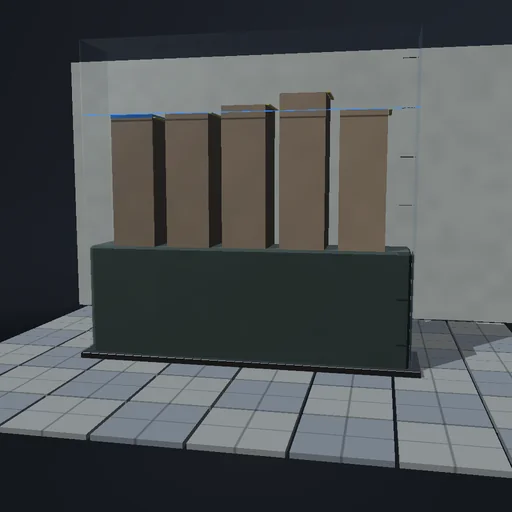
Stand five columns of crust of different thickness in the mantle: each floats so that the pressure at depth is the same, the thick column standing high on a deep root. Load one with an ice sheet and watch it sink towards rho_i H / rho_m over the mantle’s relaxation time, then take the ice away and watch it rebound; shave a kilometre off the mountain and see its surface drop by only a sixth of that while its root shallows by the rest.
What happens
Five crustal columns of 30, 35, 45, 60 and 35 km float on the mantle by Airy isostasy: elevation (h − h_0)·(1 − ρ_c/ρ_m), root (h − h_0)·ρ_c/ρ_m, and the same pressure under every column at the compensation depth. An ice sheet on the last column depresses it by ρ_i·H/ρ_m; eroding the mountain column lowers its surface by only 1 − ρ_c/ρ_m of what was cut and shallows its root by the rest. Every surface relaxes towards its equilibrium with the mantle’s viscous time constant, an exact exponential step; one second of the experiment is one thousand years.
Try this
Read the five elevations and roots, then load the last column with ice and watch it sink over a few relaxation times; take the ice away and it rebounds. Erode the mountain and compare the drop of its surface with the rock removed.
The model and its limits
Local Airy columns without flexural strength, a single relaxation time instead of mantle flow, the ice as a load without its own flow. Pressures are those of the model’s columns.
Equations used in the module
Equations
e = (h − h_0)·(1 − ρ_c/ρ_m),  root = (h − h_0)·ρ_c/ρ_m
w = ρ_i·H/ρ_m
ds/dt = (e_eq − s)/τ
P = g·(ρ_i·H + ρ_c·h + ρ_m·(D − h + e))