Earth
Rift valley formation
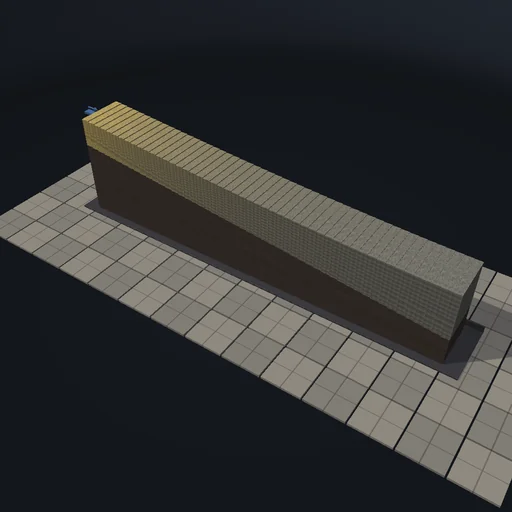
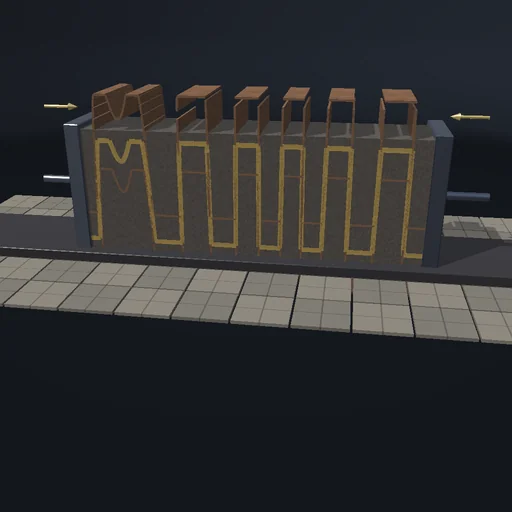
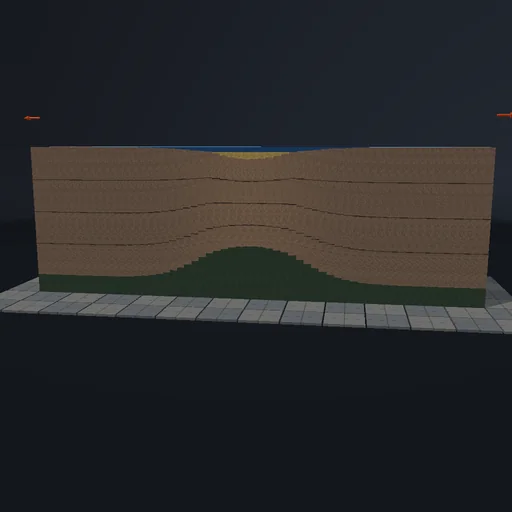
Stretch a continent and watch the crust thin over the rift, sag into a valley of stepped blocks and fill with sediment and water; the crust that leaves the window is booked, so crust plus exported area never changes, and the profile stays mirror-symmetric. Stretch fast over a viscous mantle and the floor lags its equilibrium depth; turn the sediment off and the valley floor lies deeper on the same basement.
What happens
A 300 km section of crust in 60 columns extends at a set rate: the strain rate is a Gaussian zone normalized so the plates separate at that rate, each column thins by the exact exponential of its strain, and the crust that leaves the window is booked, so crust plus exported area is constant to rounding. Airy isostasy gives the equilibrium surface - the thinned crust sinks, the sediment loads it further - and the actual surface relaxes to it with the mantle’s viscous time constant; sediment at the supply rate fills the lowest column while it lies below sea level. The stretching factor β is the initial over the thinnest crust; one second of the experiment is one Myr.
Try this
Watch the centre thin and sag and the sediment fill the floor; stretch faster over a slower mantle and read how far the surface lags its equilibrium; turn the sediment off and compare the depths.
The model and its limits
A prescribed strain zone instead of fault mechanics, pure-shear thinning, local Airy isostasy with one relaxation time, sediment laid in one column. A teaching section, not a basin model.
Equations used in the module
Equations
dh_i/dt = −v·f_i·h_i/Σ f_j·Δx,  h_i(t) = h_0·e^(−v·f_i·t/Σ f_j·Δx)
e = ((ρ_m − ρ_c)·(h − h_0) + (ρ_m − ρ_s)·s)/ρ_m
dE/dt = (e − E)/τ
β = h_0/h_min