Earth
Hotspot island chain
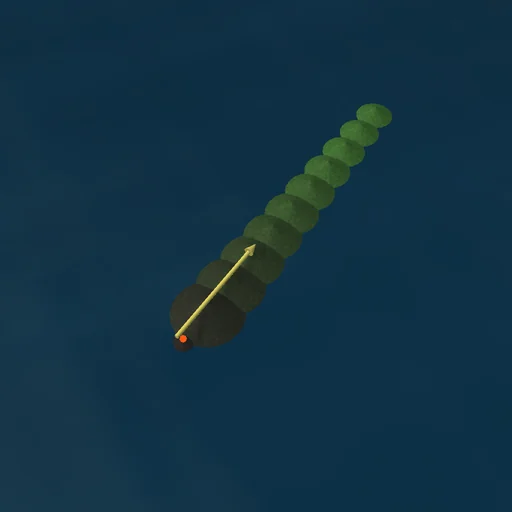
Move an ocean plate over a mantle plume and read the chain it leaves: distance over age difference is the plate’s speed, the islands subside with the cooling lithosphere and erode once above the sea until the oldest are seamounts, and a change of course at 40 Myr bends the chain by exactly the change of azimuth without touching the old islands. Let the plume drift and the chain shifts with it.
What happens
An oceanic plate moves over a mantle plume at a set speed and azimuth (1 cm/yr is 10 km/Myr). Every Myr a new island is seeded over the plume and every island rides with the plate, gathering volcanic volume at the plume’s Gaussian output while it is within reach; it stands as a cone of the set slope on a 4 km sea floor, sinks with the cooling lithosphere as k·(√(t + 1) − 1) and loses height to erosion while it is above the sea, the eroded volume booked so that volume plus eroded equals erupted. The plate turns to a new azimuth at the turn time; the plume may drift. Chain length over the oldest age is the plate speed and the bend is the change of azimuth.
Try this
Watch the chain grow and the oldest islands sink; at 40 Myr the course changes and the chain bends by the azimuth change. Give the plume a drift and see the chain shift.
The model and its limits
A fixed-output plume with a Gaussian reach, cones of one slope, a square-root subsidence law and erosion linear in height; no flexure, no reef growth, no real chain reproduced.
Equations used in the module
Equations
dx/dt = v,  v = 10·u (km/Myr per cm/yr)
dV/dt = Q·e^(−d²/r_p²)
H = (3·V·tan²φ/π)^(1/3)
z = H − D − k·(√(t + 1) − 1) − Δh