MakarovSuites
English
EnglishDeutschРусскийУкраїнськаFrançaisEspañolItalianoPolski
Contact & licences

Earth

Mantle convection

Heat a layer of slow fluid from below: at a small Rayleigh number a disturbance dies away and the conducting profile stays, above the critical value hot plumes rise and cold sheets sink and the Nusselt number climbs above one. Make the lid rigid and watch the surface stop moving and the heat transport fall; raise the Rayleigh number and the cells speed up and thin their boundary layers.
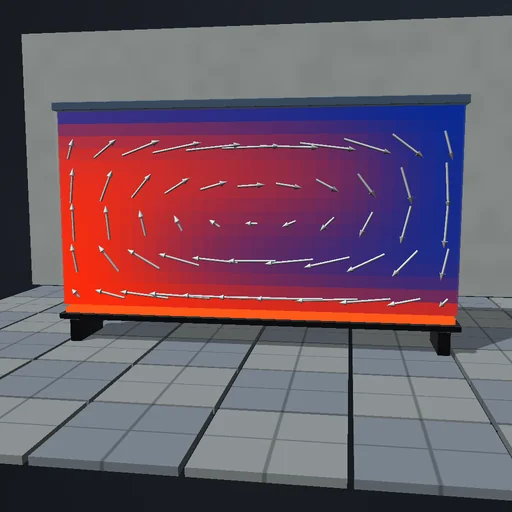
Mantle convection — Actual application image
Actual application image

What happens

Two-dimensional Boussinesq convection at infinite Prandtl number in a 2:1 box heated from below, in stream-function and vorticity form: ∇²ω = −Ra·∂T/∂x and ∇²ψ = −ω are relaxed together by Gauss–Seidel sweeps (a free lid has ω = 0 at the top, a rigid lid ω = −2ψ_1/Δz²), the velocity u = ∂ψ/∂z, w = −∂ψ/∂x is discretely divergence-free, and the temperature is advected upwind and diffused explicitly with the step held under both the diffusive and the Courant limits. The Nusselt numbers at the top and the bottom, the largest speed and the Poisson residual are read; the 32 × 16 grid is coarse, so the numbers are those of this grid.

Try this

Lower the Rayleigh number to a few hundred and watch the disturbance die; raise it and watch the plumes form and the Nusselt number climb; switch to a rigid lid and compare.

The model and its limits

A coarse 32 × 16 grid, first-order upwind advection, a fixed number of relaxation sweeps (the residual is shown), constant viscosity, no internal heating or phase changes. Dimensionless; not the mantle’s numbers.

Equations used in the module
Equations
∇²ω = −Ra·∂T/∂x,  ∇²ψ = −ω
u = ∂ψ/∂z,  w = −∂ψ/∂x
∂T/∂t + u·∂T/∂x + w·∂T/∂z = ∇²T
Nu = −(1/W)·∫ ∂T/∂z dx
Related experiments

Back to catalogue
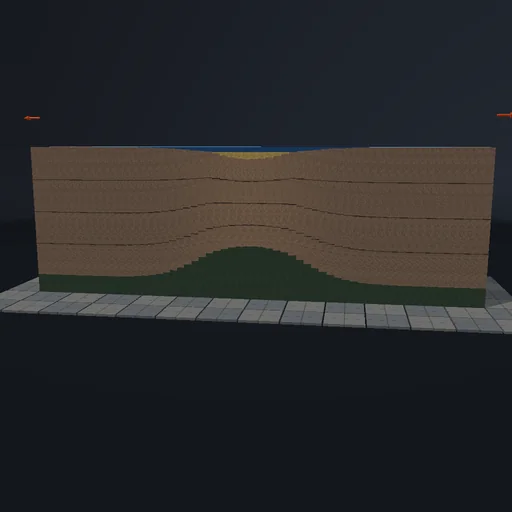
Rift valley formation — Actual application image

Earth

Rift valley formation

Stretch a continent and watch the crust thin over the rift, sag into a valley of stepped blocks and fill with sediment and water; the crust that leaves the window is booked, so crust plus exported area never changes, and the profile stays mirror-symmetric. Stretch fast over a viscous mantle and the floor lags its equilibrium depth; turn the sediment off and the valley floor lies deeper on the same basement.

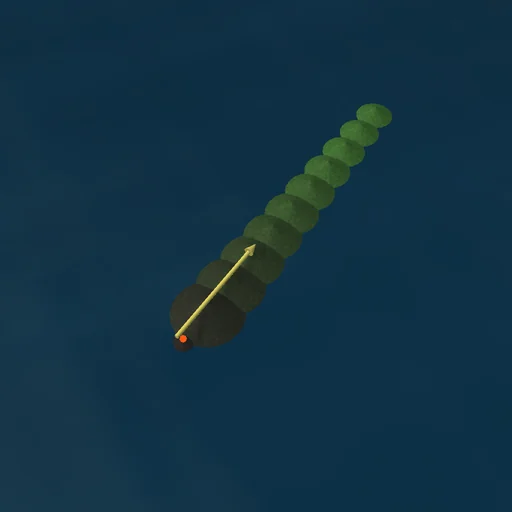
Hotspot island chain — Actual application image

Earth

Hotspot island chain

Move an ocean plate over a mantle plume and read the chain it leaves: distance over age difference is the plate’s speed, the islands subside with the cooling lithosphere and erode once above the sea until the oldest are seamounts, and a change of course at 40 Myr bends the chain by exactly the change of azimuth without touching the old islands. Let the plume drift and the chain shifts with it.

Sedimentary basin — Actual application image

Earth

Sedimentary basin

Watch a 100 km basin fill over ten million years: the basement sinks faster the farther from the hinge, sediment arrives at the hinge and spreads downslope by diffusion, faster on land than under water, and every quarter million years a marker bed is laid. Sand stays near the source and mud travels on; porosity squeezes out with depth so the compacted pile stands taller than the solid it holds. Raise the sea and the shoreline retreats; triple the supply and the basin overfills and spills past its far edge. Supplied, exported and held sediment balance to rounding, and a diffusing mound spreads its variance by exactly 2 K t.