Engineering
Helical gear pair
Change the helix angle and hand at the same load and read the axial thrust on the bearings. The tooth force is solved along the tooth normal; the thrust is a bearing reaction, not a formula.
What happens
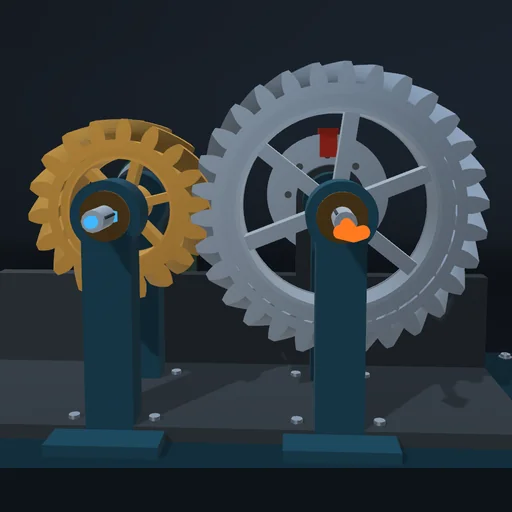
A helical pinion with 18 teeth drives a 30-tooth wheel on parallel shafts against a brake. The teeth are inclined to the axis by the helix angle β, so the tooth force has three parts: the tangential force carries the torque, the radial force pushes the shafts apart, and the axial force pushes each gear along its shaft. Raise β from 0 to 40° at the same load: the tangential force does not change, while the thrust grows as tan β and lands on the thrust bearings, in opposite directions on the two shafts. Reverse the drive or swap the hand of the teeth and the thrust changes side.
Model: rigid gears and shafts; one ideal tooth contact at the pitch point along the inclined tooth normal; the thrust is the reaction measured in the bearing. The radial force follows from the 20° pressure angle. No friction, backlash or tooth deflection; the motor holds its speed up to its torque limit.
Try this
Change the helix angle at a constant load and compare the thrust with the tangential force; reverse the drive or swap the hand and the thrust changes side.
Equations used in the module
Equations
Ft = T₁/r₁
Fa = Ft·tan β
Fr = Ft·tan αn / cos β,  αn = 20°
ω₂/ω₁ = −z₁/z₂