Engineering
Planetary gear train
Hold the ring, then the sun, then the carrier, and drive the train: one equation ties the three speeds together. Drive the sun and the ring at once, then hold two members and try to turn the third.
What happens
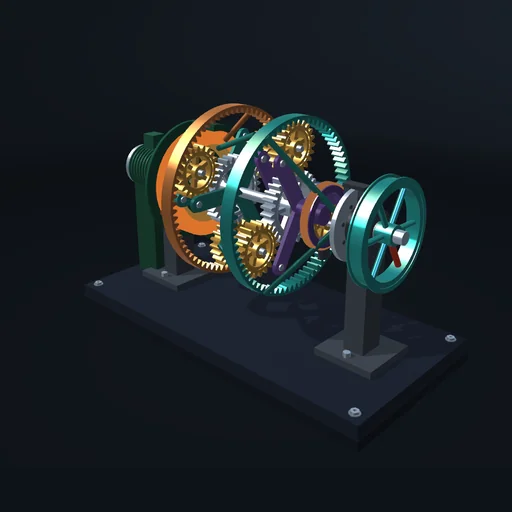
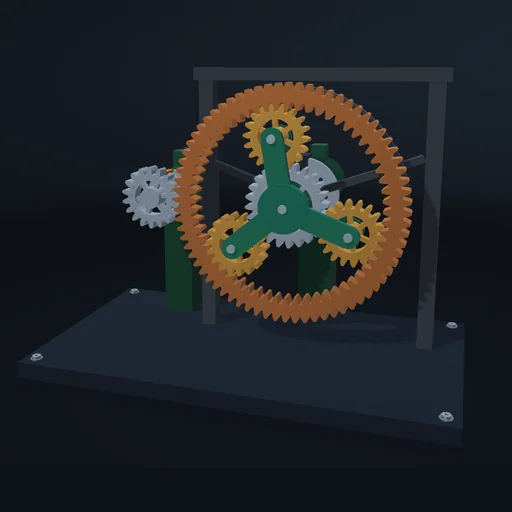
A sun of 24 teeth, three planets of 18 on a carrier and a ring of 60 teeth. Motors and brakes on the three members – on the ring through a side pinion on its outer teeth – drive, hold or load any of them. Whatever is held or driven, the three speeds obey Willis’ equation (ωs − ωc)/(ωr − ωc) = −zr/zs = −2.5. Ring held: the carrier turns zs/(zs + zr) = 0.286 of the sun, a strong reduction. Sun held: the carrier turns 0.714 of the ring. Carrier held: the train is an ordinary gear pair with idlers, and the ring turns −0.4 of the sun. Drive the sun and the ring at once, and the carrier takes a weighted mean of their speeds. The torques keep fixed proportions, Ts : Tr : Tc = zs : zr : −(zs + zr), and add up to zero; a held member’s brake carries its share. Hold two members, and the third cannot turn at all: its motor stalls.
Model: rigid gears, each on its own bearing, the planets on pins on the carrier; every mesh is a contact along the line of action without friction or backlash. No tooth elasticity or bearing losses; the three planets share the load as the solver finds it.
Try this
Try each arrangement and compare the carrier’s speed with the sun’s: the Willis ratio stays −2.5. Then hold two members.
Equations used in the module
Equations
(ωs − ωc)/(ωr − ωc) = −zr/zs
zs ωs + zr ωr = (zs + zr) ωc
Ts : Tr : Tc = zs : zr : −(zs + zr)