Math
Knots
Torus knots and links: the trefoil, the cinquefoil, Solomon's link, and the crossings a picture cannot get rid of.
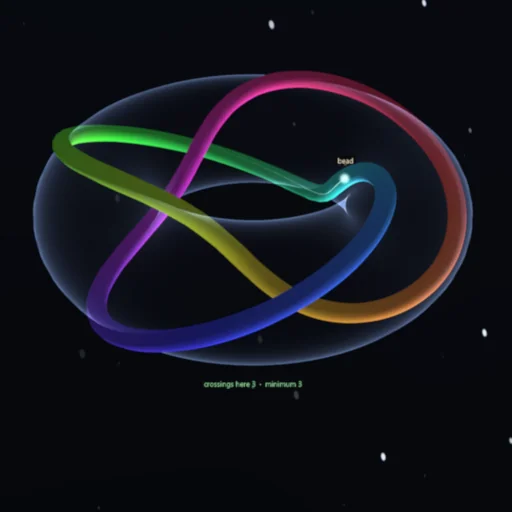
What happens
Wind a curve p times round the hole of a torus and q times round its tube and you have T(p, q): a knot when p and q share no factor, a link of gcd(p, q) pieces when they do. The picture here counts its own crossings for whatever view the camera has, and the number never drops below min(p(q − 1), q(p − 1)) - that is what an invariant is. Look straight down the torus axis and it lands on the minimum. Swap p and q: the picture changes, the knot does not, and the invariants say so. A bead runs the whole curve to show it is one; each component of a link gets its own colour and its own bead.
Equations used in the module
Equations
T(p, q):  x = (R + r cos qt) cos pt,  y = (R + r cos qt) sin pt,  z = r sin qt
components = gcd(p, q);   crossing number c = min(p(q − 1), q(p − 1))
genus = (p − 1)(q − 1)/2;   Δ(t) = (t^pq − 1)(t − 1) / ((t^p − 1)(t^q − 1))
T(p, q) = T(q, p): the same knot, another picture