Math
The isoperimetric problem
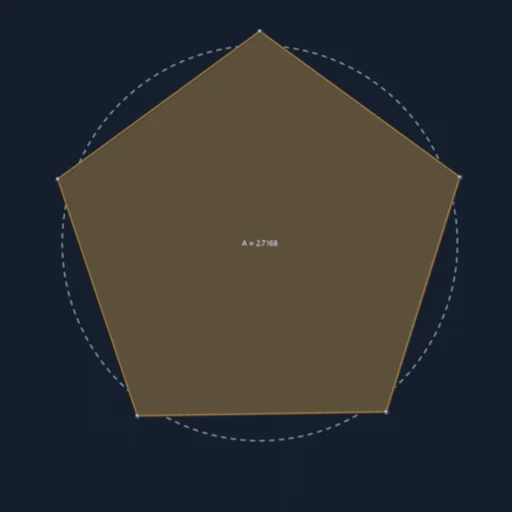
One cord of fixed length on pins: add sides and watch the enclosed area grow toward the circle's while a ruler shows the cord is still the same length; then predict which of two shapes from the same cord holds more, and check.
What happens
A cord of fixed length L is laid around pins. Which shape encloses the most? Add sides one by one: the cord is always the same length - the ruler below lays it out straight - yet the shaded area grows, and Q = 4πA/L² climbs toward 1, the circle made from the same cord. Then predict: of two shapes from the same cord, which holds more? Some pairs are traps. The experiment compares particular shapes; it is not a proof that the circle beats every curve.
Equations used in the module
Equations
Q = 4πA / L² ≤ 1,  equality only for the circle
regular n-gon:  A(n) = L² / (4n·tan(π/n)),   Q(n) = π / (n·tan(π/n)) → 1
circle from the same cord:  A = L² / (4π)
here L = 2π, so the circle holds A = π