MakarovSuites
English
EnglishDeutschРусскийУкраїнськаFrançaisEspañolItalianoPolski
Contact & licences

Earth

Tides in an estuary

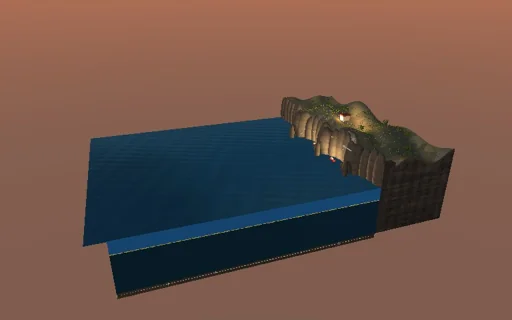
Watch the evening tide run up a funnel-shaped estuary past the lighthouse: the channel narrows towards the river, so the wave rises as it goes and the range at the head is far larger than at the mouth, the flood is shorter than the ebb, and the salt sea water pushes tens of kilometres inland against the river. Raise the river’s discharge and the salt is pushed back towards the sea; make the funnel sharper or straighten it; close the head and the channel resonates as a quarter-wave, the head’s tide a / cos(kL) of the sea’s. Calm closed water stays exactly calm, a salt estuary with no river stays exactly salt, and the water and salt balance against what crossed the mouth and the head.
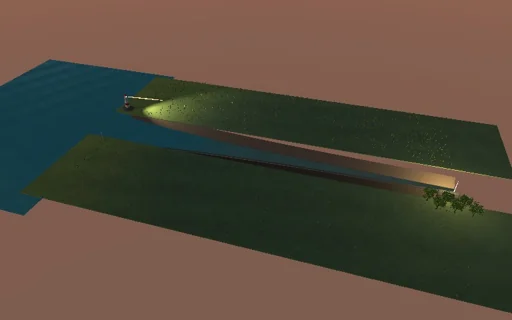
Tides in an estuary — Actual application image
Actual application image

What happens

A 60 km channel 8 m deep whose width narrows from 3 km as exp(−x/25 km), in 120 cells on a staggered grid: the surface at cell centres, the velocity at faces. Forward-backward steps of 20 s update the surface from the face discharges, then the velocity from the new surface slope, with upwind advection and implicit Manning friction. The sea’s M2 tide of 1.5 m comes in at the mouth over two periods; the river brings 100 m³/s at the head. Salt rides the same discharges upwind with a tidal dispersion of 150 m²/s, so a salt estuary with no river stays salt and calm closed water stays calm. A closed prismatic channel checks the quarter-wave a/cos(kL).

Try this

Watch the range grow up the funnel and the flood run shorter than the ebb; raise the river and push the salt out; straighten or sharpen the funnel; close the head and compare with the quarter-wave.

The model and its limits

A one-dimensional, well-mixed channel of uniform depth, no drying of the flats, salinity without density effects, a single tidal constituent. Ranges belong to this idealized estuary.

Equations used in the module
Equations
b·∂η/∂t + ∂(b·H·u)/∂x = 0,  b = b0·e^(−x/L_b)
∂u/∂t + u·∂u/∂x = −g·∂η/∂x − g·n²·|u|·u/H^(4/3)
∂(b·H·S)/∂t + ∂(b·H·u·S − b·H·K·∂S/∂x)/∂x = 0
closed prismatic channel: a_head = a/cos(kL),  k = ω/√(g·h)
Related experiments

Back to catalogue
Ocean gyres — Actual application image

Earth

Ocean gyres

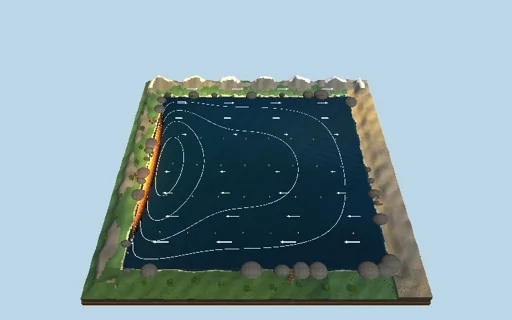
Look down on an ocean basin laid out like a relief table in the sun and let the winds drive it: trade winds in the south and westerlies in the north twist the sea into a gyre, and because the Coriolis parameter grows northwards the return flow does not spread across the ocean but squeezes into a narrow, fast current along the western shore, like the Gulf Stream, while the whole interior creeps slowly south at Sverdrup’s transport. Buoys and ships ride the current and the sea surface stands highest in the gyre’s centre. Switch off the β-effect and the gyre turns symmetric; strengthen the friction or move to a higher latitude and the western current widens as r/β, or as (A/β)^(1/3) with Munk’s viscosity; add a subpolar gyre; stop the wind and watch it decay. Stommel’s exact solution stands beside the numbers, and the wind’s work balances the friction to round-off.

Density drives the ocean — Actual application image

Earth

Density drives the ocean

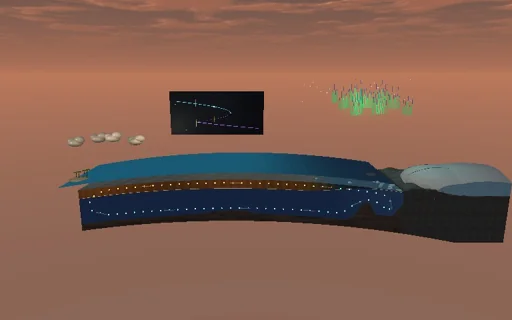
Watch the Atlantic overturn, cut open from the tropics to the Arctic: warm salty water runs north on top, gives its heat to the polar air, grows dense and sinks in the Nordic Seas, and returns south along the bottom - Stommel’s two boxes joined by the flow q = K(αΔT − βΔS). Cold makes the polar water denser, fresh water makes it lighter: melt the Greenland ice sheet and the overturning weakens along a closed-form equilibrium curve until, past the critical freshwater flux of 0.66 Sv, no thermal state is left and the circulation collapses within centuries, reverses and carries only a fraction of the heat north. Take the meltwater away and it does not come back - it recovers only once the north turns net evaporative. Sweep the flux slowly up and down and trace the hysteresis loop on the board; salt and heat are booked to round-off.

Coastal upwelling — Actual application image

Earth

Coastal upwelling

Let an equatorward wind blow along a rocky eastern-boundary coast in the low evening sun and watch the sea turn cold: the Earth’s rotation turns the wind-driven surface water to the right of the wind, offshore, at Ekman’s transport τ/(ρf), and cold deep water comes up to replace it. In the cut-away ocean the interface between the warm layer and the deep water tilts up towards the coast within a Rossby radius sqrt(g’H)/f, rising steadily as Gill’s closed form τt/(ρfR) e^(−x/R), and a geostrophic jet runs along the shore. The surface cools where the mixed layer reaches the cold water, fog gathers over it, boats and seabirds come, and plankton bloom days later. Reverse the wind, turn the coast round or move it to the other hemisphere and the water sinks instead; the volume exported offshore balances to round-off.