MakarovSuites
English
EnglishDeutschРусскийУкраїнськаFrançaisEspañolItalianoPolski
Contact & licences

Engineering

Tiltrotor transition

Transfer lift from two tilting rotors to a wing. Test whether available shaft power and transition time are enough to keep altitude as the aircraft accelerates.
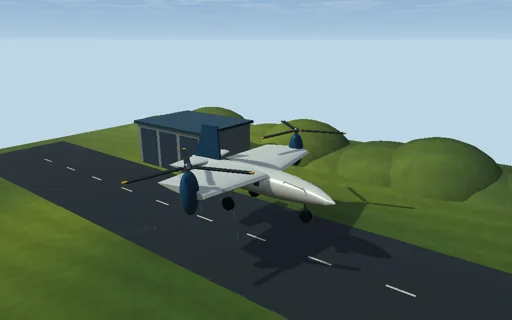
Tiltrotor transition — Actual application image
Actual application image

What happens

Start in hover, then tilt the nacelles. Compare a gradual transition with a fast one, or add payload. The altitude controller can request thrust but cannot exceed the power limit.

Longitudinal point mass with imposed level attitude, two ideal actuator discs and a smooth stalled wing polar. No roll, yaw, rotor-wing interference or vortex-ring state. Generic aircraft, not certified performance data. The tracking view compresses height and ground travel; readings use real SI units.
Try this

Start in hover, then tilt the nacelles. Compare a gradual transition with a fast one, or add payload. The altitude controller can request thrust but cannot exceed the power limit.

The model and its limits

Longitudinal point mass with imposed level attitude, two ideal actuator discs and a smooth stalled wing polar. No roll, yaw, rotor-wing interference or vortex-ring state. Generic aircraft, not certified performance data. The tracking view compresses height and ground travel; readings use real SI units.
Related experiments

Back to catalogue
Emergency braking and ABS — Actual application image

Engineering

Emergency braking and ABS

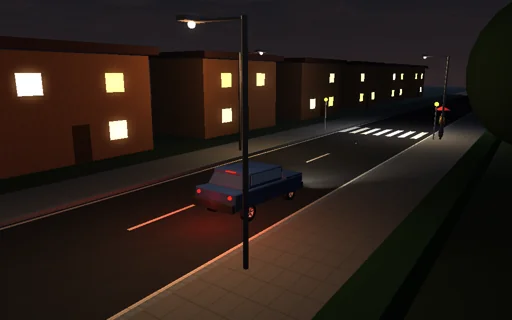
A pedestrian crossing appears 70 m ahead of a car doing 100 km/h on a night road. The driver needs a second to react, then the pedal pressure ramps up and reaches the calipers through the hydraulics. Without ABS the wheels lock, the tyres slide at the friction of full slip and leave black marks behind - on dry asphalt the slide after lock-up is exactly v^2/(2 mu g) and the car ends up on the crossing. With ABS each axle’s valves rise, hold and dump on slip and wheel deceleration, keeping the slip near the peak of the tyre curve: the car stops short, between the closed forms with the peak and the sliding friction, and the front wheels keep the grip to steer. Try wet asphalt, snow and ice - on ice the curve has no peak and ABS gains nothing - slow the controller down, and follow every joule into the brakes, the tyres and the rolling.

Crash sled and crumple zones — Actual application image

Engineering

Crash sled and crumple zones

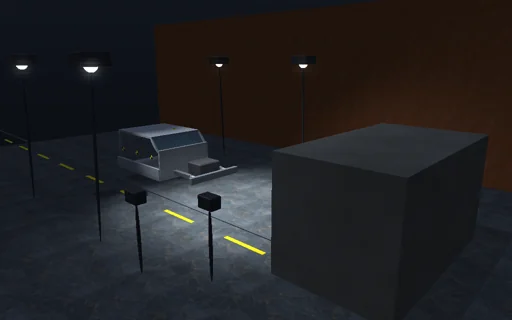
Tow a car into a concrete barrier under the floodlights of a crash hall and watch it in slow motion. The two crash boxes fold lobe by lobe at the mean force the Abramowicz-Jones formula gives for their wall thickness and width; at fifteen kilometres an hour they take all the energy and the car stops exactly where the folding work equals its kinetic energy. At fifty-six the rails behind them fold too, at eighty the engine block bottoms on the barrier and the deceleration soars. The belted dummy slides through the slack before the belt takes him - give the belt more slack and his peak deceleration and head injury criterion rise. Every joule is followed into the folds, the belt and the rebound.