Engineering
Emergency braking and ABS
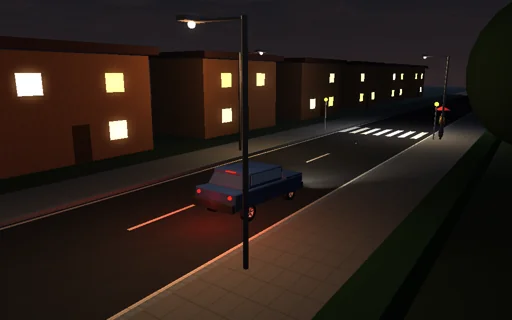
A pedestrian crossing appears 70 m ahead of a car doing 100 km/h on a night road. The driver needs a second to react, then the pedal pressure ramps up and reaches the calipers through the hydraulics. Without ABS the wheels lock, the tyres slide at the friction of full slip and leave black marks behind - on dry asphalt the slide after lock-up is exactly v^2/(2 mu g) and the car ends up on the crossing. With ABS each axle’s valves rise, hold and dump on slip and wheel deceleration, keeping the slip near the peak of the tyre curve: the car stops short, between the closed forms with the peak and the sliding friction, and the front wheels keep the grip to steer. Try wet asphalt, snow and ice - on ice the curve has no peak and ABS gains nothing - slow the controller down, and follow every joule into the brakes, the tyres and the rolling.
What happens
A 1500 kg car, wheelbase 2.7 m, centre of mass 1.1 m behind the front axle and 0.55 m high; each axle is one wheel of 0.31 m radius and 2.4 kg·m² carrying the axle’s load, which moves forward by m·a·h/L through a 0.15 s pitch lag. The tyre force is mu(s)·N on the Burckhardt curve mu = c1(1 − e^(−c2 s)) − c3 s: dry asphalt peaks at 1.17 near 17 % slip and slides at 0.76, wet asphalt 0.80 and 0.51, snow 0.19 and 0.13, ice 0.05 with no peak at all. After a 1 s reaction the driver’s 12 MPa ramps up in 0.15 s and fills the calipers with a 30 ms lag; the brakes give 400 and 180 N·m per MPa front and rear. Without ABS both axles lock. With ABS a 100 Hz controller per axle dumps the caliper (80 ms) when the slip passes 0.18 or the wheel decelerates faster than 16 m/s² above 0.12 slip, holds while the wheel spins back up, and rises again in 50 ms pulses below 0.12. Rolling resistance is 1 % of the load. The wheel is advanced semi-implicitly with the tyre force linearised in its speed, the body explicitly with the same force, in 0.2 ms steps; the kinetic energy of body and wheels is booked into brake heat T·ω, tyre slip heat F·(v − ωR) and rolling with the step’s own mean speeds, so the ledger closes to round-off. The steering grip is Burckhardt’s combined slip at 4° of slip angle on the front axle.
Try this
Brake from 100 km/h on dry asphalt with and without ABS and compare the stopping points with the crossing; look at the skid marks and the steering grip; try wet asphalt, snow and ice; slow the controller to 20 Hz.
The model and its limits
A straight stop of a rigid two-axle car, one wheel per axle, quasi-static pitch, Burckhardt curves independent of speed and load, an ideal speed reference for the controller, no yaw, no split-mu. Distances are those of this idealized car, not a safety rating of a real one.
Equations used in the module
Equations
μ(s) = c1·(1 − e^(−c2·s)) − c3·s,  s = (v − ω·R)/v,  F = μ(s)·N
I·dω/dt = F·R − k_b·p − C_rr·N·R,  m·dv/dt = −(F_f + F_r)
N_f,r = m·g·(L − a, a)/L ± ΔN,  τ_p·dΔN/dt = m·a_x·h/L − ΔN
d = v²/(2·μ·g),  ½·m·v0² + ½·ΣI·ω0² = Q_brake + Q_slip + Q_roll + E_k