Earth
Tropical cyclone heat engine
Spin up a tropical storm over a warm sea at dusk: the sea gives heat to the inflowing air at its surface temperature, the outflow gives it up a hundred degrees colder at the tropopause, and this Carnot engine sets the strongest wind the storm can reach - the potential intensity. Over a sea that does not cool the wind follows the closed-form tanh law up to that limit; let the storm stir up the cold water beneath it and it holds itself lower, much lower over a shallow warm layer; shear the vortex and it settles weaker; take it ashore and, with no heat supply and rougher ground, the wind decays exactly as V0/(1 + C_D V0 t/2h). With no temperature difference there is no engine at all.
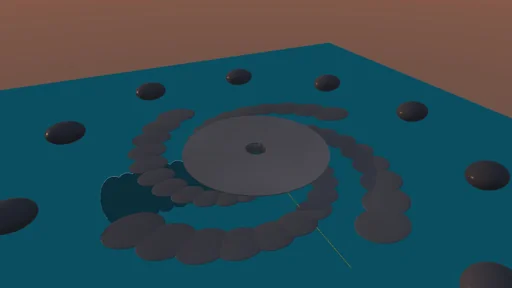
What happens
The potential intensity V_p² = (C_k/C_D)·(T_s − T_o)/T_o·(k*_s − k_a) from the saturation enthalpy of the sea surface and the air above it at 80 % humidity, a −73 °C outflow and C_k/C_D = 0.75. The maximum wind relaxes towards it, dV/dt = C_D (V_p² − V²)/(2h) − kappa S V/h with h = 15 km; the storm cools the warm layer under it by the enthalpy it takes and by stirring up water from below, against the warm water it moves over. Over land the enthalpy supply stops and the drag doubles. Holland’s profile with b = 1.5 gives the wind at every radius and the central pressure. RK4 at 1 min; the kinetic energy gained is the generation less the dissipation.
Try this
Spin the storm up and compare it with the tanh law; let it cool the sea; thin the warm layer; shear it; send it ashore and compare the decay with the closed form.
The model and its limits
A single-number intensity model with a bulk ocean layer, no structure, asymmetry or track; the cloud bands are decoration, not resolved dynamics. Intensities are those of this idealized engine.
Equations used in the module
Equations
V_p² = (C_k/C_D)·(T_s − T_o)/T_o·(k*_s − k_a)
dV/dt = C_D·(V_p² − V²)/(2h) − κ·S·V/h
V = V_p·tanh(C_D·V_p·t/2h + atanh(V0/V_p)),  land: V = V0/(1 + C_D·V0·t/2h)
V(r) = V_m·√(x·e^(1 − x)),  x = (R_m/r)^b,  Δp = ρ·V_m²·e/b