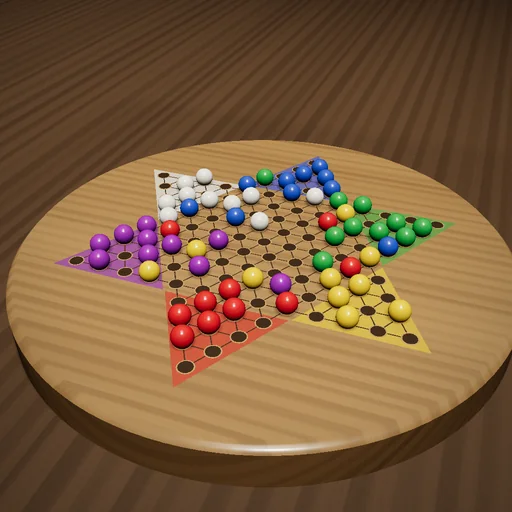
Chinese checkers on the star board with glass marbles, for two, three, four or six players: move one marble a turn - a step to the next hole or a chain of jumps over single marbles, your own or anyone's - and be the first to fill the point opposite your own. Click a marble to see every hole it can reach; it hops there jump by jump. Play the computer in the other seats at five levels, pass the board round at one screen, ask for a hint, take moves back, or watch a demo game.
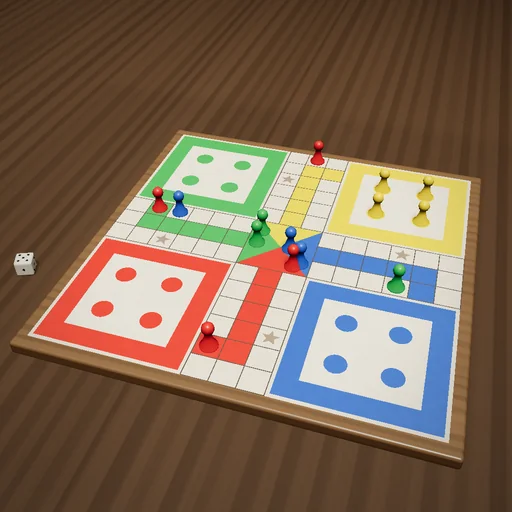
Ludo for two to four players: roll the die, bring your four pawns out of the yard with a six, race them round the loop and up the home column - home takes the exact number. A pawn landing on another sends it back to its yard, except on the start and star squares; a six, a capture and a pawn home each earn another roll, and three sixes in a row lose the turn. The die tumbles on the table and the pawns hop square by square. Play the computer in the other seats at five levels, pass the die round at one screen, or watch a demo game.
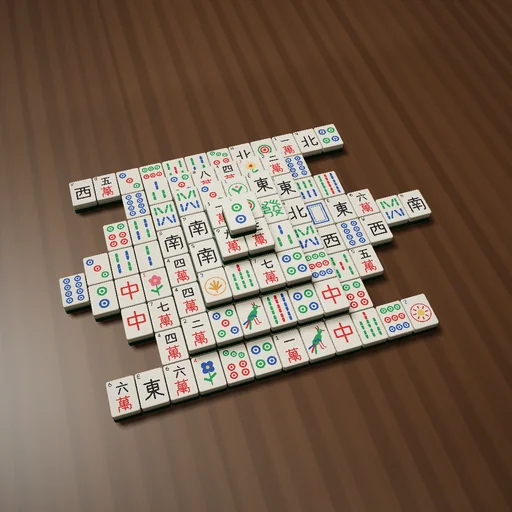
Mahjong solitaire with the full set of 144 tiles, laid out as the Turtle, a Pyramid or a Fortress: take the tiles away two at a time - a free tile and another free tile with the same face; any flower goes with any flower and any season with any season. A tile is free when nothing lies on it and its left or its right side is open. Every deal can be cleared to the last tile. Take moves back, ask for a hint - it looks for a way to clear the whole table - have the free tiles marked, shuffle what is left when no pair is open, or watch the computer solve a deal.
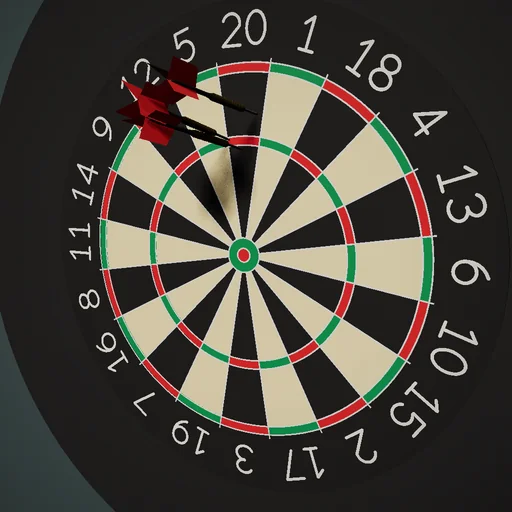
Darts at a clock board: 301, 501 or 701, taken down to exactly nothing, three darts a turn. Played to a double, the last dart has to land in the double ring or the bull, and a dart that takes the score past nothing, or to one, is a bust: the turn is over and the score goes back. The sight sways about the pointer like a hand that will not keep still - let the dart go when it crosses the bed you want. The computer's darts scatter about the point it aims at, less at each of its five levels, and it aims where its own hand does best: a beginner at the fat part of the board, a master at the treble twenty and the shortest way out. Play the computer or a friend, practise alone or watch a demo game; a hint shows where a hand like yours should aim.
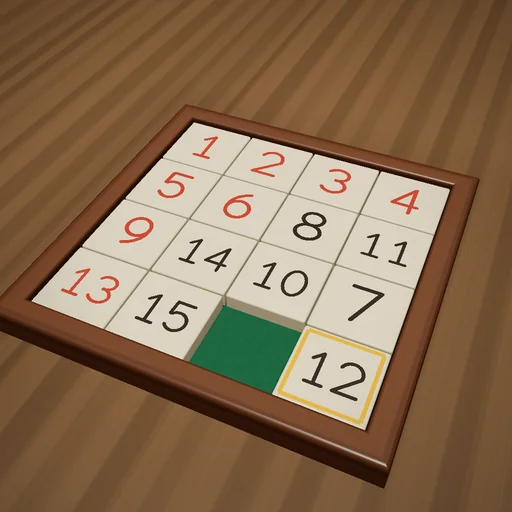
The fifteen puzzle: a tray of numbered ivory tiles with one cell empty - slide them until they stand in order. Play the classic 4 by 4 with fifteen tiles, the small 3 by 3 with eight or the large 5 by 5 with twenty-four; every shuffle can be solved. Click a tile to push it, and the tiles between, toward the gap, or use the arrow keys. The moves and the time are counted. Ask for a hint - the solver finds the shortest way on the small board and a short one on the larger - take moves back, or let the computer put the tiles in order.
Some modules belong to more than one Suite. Shared experiments have one description here.