Games
Darts
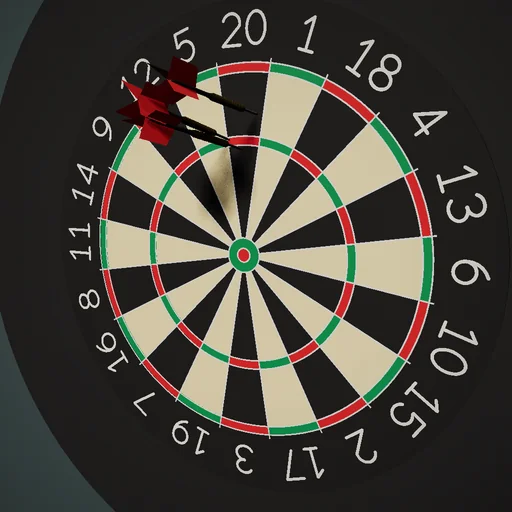
Darts at a clock board: 301, 501 or 701, taken down to exactly nothing, three darts a turn. Played to a double, the last dart has to land in the double ring or the bull, and a dart that takes the score past nothing, or to one, is a bust: the turn is over and the score goes back. The sight sways about the pointer like a hand that will not keep still - let the dart go when it crosses the bed you want. The computer's darts scatter about the point it aims at, less at each of its five levels, and it aims where its own hand does best: a beginner at the fat part of the board, a master at the treble twenty and the shortest way out. Play the computer or a friend, practise alone or watch a demo game; a hint shows where a hand like yours should aim.
What happens
The board. Twenty sectors numbered 1 to 20. A dart in a sector scores its number; in the narrow outer ring, the double, twice the number; in the narrow inner ring, the treble, three times. The outer bull scores 25, the bull 50. Outside the double ring a dart scores nothing. The game. Each player starts with 301, 501 or 701 and throws three darts a turn; what they score is taken off. The first to reach exactly nothing wins. On a double: the last dart must land in a double or in the bull, which counts as the double of 25. A dart that takes the score below nothing, to exactly one, or to nothing without a double is a bust: the turn ends and the score goes back to what it was before the turn. Any dart: a dart that leaves exactly nothing wins, and only going below nothing is a bust. Writing. T20 is the treble of 20, D16 the double of 16, 25 the outer bull, 50 the bull. Throwing. The pointer shows where you aim; the sight sways about it, and the dart goes where the sight is when you click. The steadier the hand you choose, the less the sight strays.
Try this
Aim with the pointer and click when the swaying sight is over the bed you want. The right mouse button turns the view, the wheel zooms.