MakarovSuites
English
EnglishDeutschРусскийУкраїнськаFrançaisEspañolItalianoPolski
Contact & licences

Math

A curve that fills a square

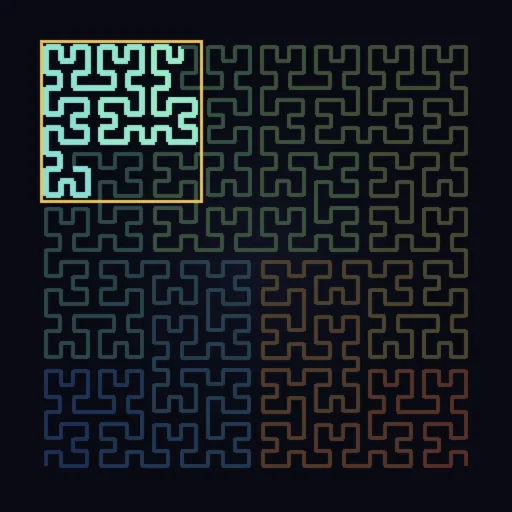
A line has no area, and yet a curve can pass through every point of a square - Peano found one in 1890, Hilbert drew his in 1891. At each order the curve visits every cell exactly once, moving one cell at a time, and the limit is continuous. Drag the marker: a tenth of the curve stays inside about a third of the side, which is why databases and image formats index space along this curve. The reverse is false, and the panel measures that too - two touching cells can be five sixths of the curve apart.
A curve that fills a square — Actual application image
Actual application image

What happens

A line has as many points as a square - Cantor proved it in 1878 and nobody wanted to believe it, and his matching tore the segment to dust. Peano and Hilbert found a continuous one: a curve that visits every cell of a grid once, refined by a rule that keeps every step one cell long, and in the limit passes through every point of the square. Its length doubles with every order while the area it fills stays one. The same rule lifts to the cube. Raise the order, follow the curve with the marker, and watch nearby points on the line stay nearby in the square - mostly.

Equations used in the module
Equations
Hilbert: the cell at distance d from the bits of d, two at a time
Peano: base 3, three cells per digit
every curve is a permutation of the cells, each step one cell
length at order n, unit square: (4^n − 1)/2^n → ∞ while the area stays 1
Related experiments

Back to catalogue
The birth of the giant component — Actual application image

Math

The birth of the giant component

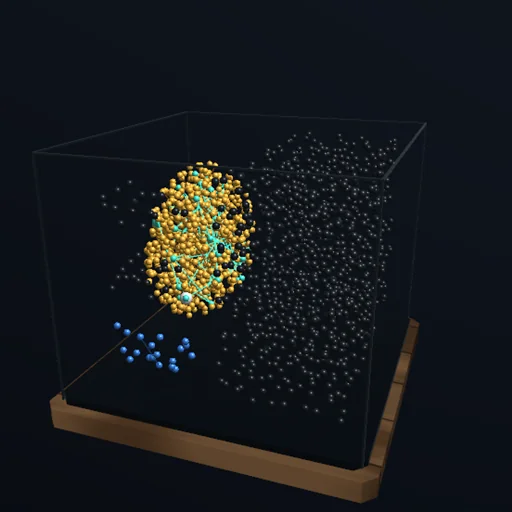
Add one edge, find a path between two vertices, then watch c pass through one. The graph and all readings use the same edge stream.

Mathematical billiards — Actual application image

Math

Mathematical billiards

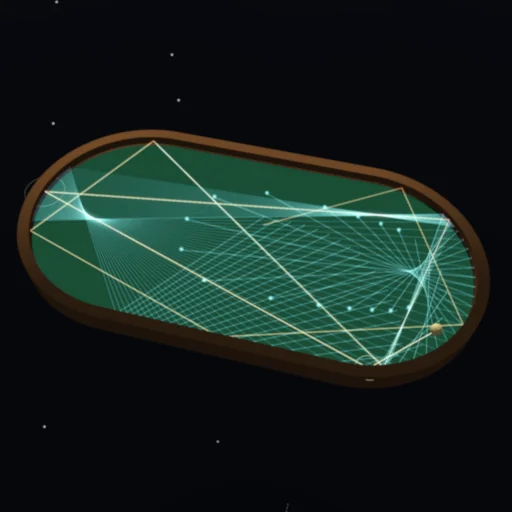
A point bouncing inside a wall with equal angles, for ever. Inside a circle the angle never changes: the path avoids a smaller circle it can never enter, and a rational rotation closes into a polygon. Inside a stadium - two half-circles joined by straight walls - nothing is conserved but the speed, and two paths a billionth of a degree apart are a table's width apart after twenty bounces. The panel measures that: the separation is fitted against an exponential AND against a straight line, and which one fits is the answer.

Why a computed trajectory lies — Actual application image

Math

Why a computed trajectory lies

A computer cannot follow a trajectory; it can only take steps. Halving the step divides the error by two, four or sixteen depending on the method - until so many steps accumulate round-off that a smaller step makes the answer WORSE. On an orbit the most accurate method of the four still loses energy in a straight line while a less accurate one merely wobbles for ever, because accuracy and respect for an invariant are different virtues. And in a chaotic system the path is doomed whatever the method: what survives is the attractor, not the trajectory.