MakarovSuites
English
EnglishDeutschРусскийУкраїнськаFrançaisEspañolItalianoPolski
Contact & licences

Math

Bounds instead of estimates

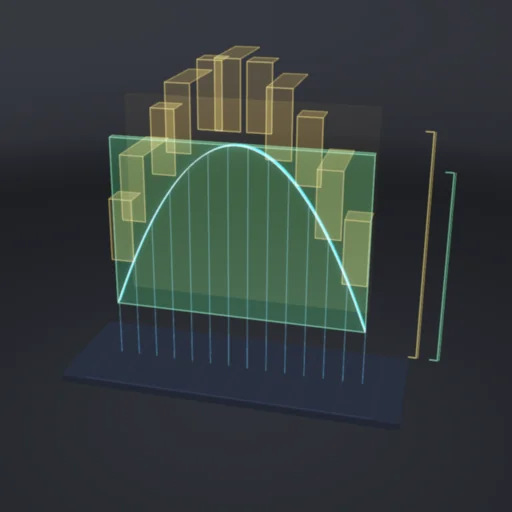
Every other way of computing gives a number that is probably right. Interval arithmetic gives a pair that is certainly right, and the whole subject is what that costs. It costs sharpness, and the cost has a name: every occurrence of a variable is treated as a different variable, so x − x comes out as an interval two units wide. Which means the enclosure is a property of the FORMULA, not of the function - rewrite x(1 − x) as 0.25 − (x − 0.5)² and the width falls from 1 to the true 0.25; write x·x instead of x² in 1/(1 + 25x²) and the answer becomes the entire real line.
Bounds instead of estimates — Actual application image
Actual application image

What happens

Every other module in this ring measures an error; this one refuses to. It computes with pairs of numbers guaranteed to contain the answer, rounding every endpoint outward, and the guarantee is the whole point: sharpness is traded for certainty. Feed x = [1, 2] into x − x and you get [−1, 1], not 0, because the arithmetic does not know the two x are the same - the dependency problem, and the reason intervals swell with every step. Divide by an interval containing zero and the honest answer is the whole line. Try the expressions, watch the widths grow, and see which rewritings keep them tight.

Equations used in the module
Equations
[a,b] + [c,d] = [↓(a+c), ↑(b+d)],  [a,b] − [c,d] = [↓(a−d), ↑(b−c)]
[a,b]·[c,d] = [↓min, ↑max] of the four products
[a,b]/[c,d] = the whole line when [c,d] contains 0
the dependency problem: x − x = [a−b, b−a], not 0
Related experiments

Back to catalogue
Slicing a surface — Actual application image

Math

Slicing a surface

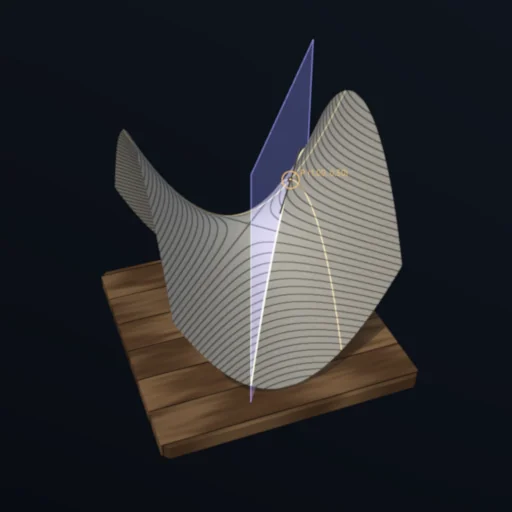
Cut a surface with a vertical plane and you get a curve; its slope is the derivative in that direction. Turn the plane and watch the slope change, then plot it in polar coordinates: for a differentiable surface that plot is exactly a circle with the gradient as its diameter, so the gradient being the steepest way up stops being a claim and becomes a picture. And one surface here has both partial derivatives, a directional derivative in every direction, and no tangent plane at all - the formula ∇f·u predicts zero while the surface climbs at 0.385, because existing is a weaker thing than differentiable.

How far a Taylor polynomial reaches — Actual application image

Math

How far a Taylor polynomial reaches

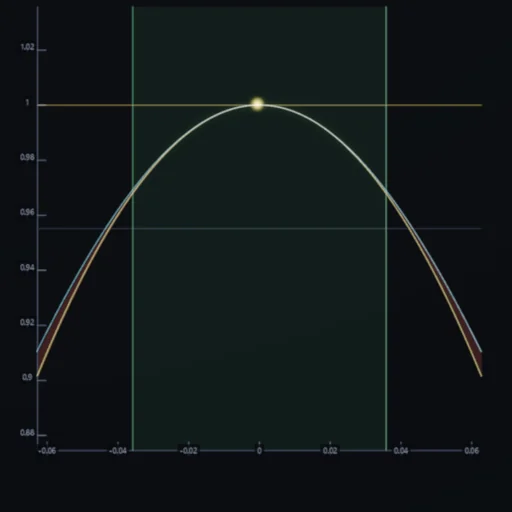
Near its centre a Taylor polynomial is indistinguishable from the function, and adding a term always pays. Away from it, three different things go wrong: outside the radius of convergence more terms make the answer worse without limit; exp(−1/x²) has a series that converges everywhere and equals the function at one point; and even inside the radius, summing far from the centre can throw away every digit. The radius itself is the distance to a singularity that is not on the real line at all, so a third scene draws the complex plane, where the answer actually lives.

Pythagoras by area — Actual application image

Math

Pythagoras by area

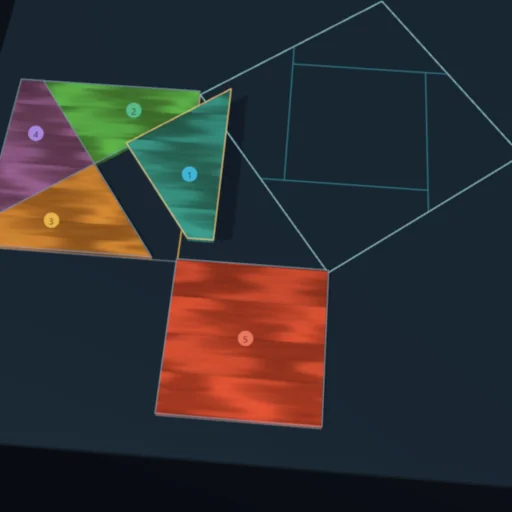
Three ways to compare areas: wooden pieces, flexible sheets, and an exact top view.