Math
How far a Taylor polynomial reaches
Near its centre a Taylor polynomial is indistinguishable from the function, and adding a term always pays. Away from it, three different things go wrong: outside the radius of convergence more terms make the answer worse without limit; exp(−1/x²) has a series that converges everywhere and equals the function at one point; and even inside the radius, summing far from the centre can throw away every digit. The radius itself is the distance to a singularity that is not on the real line at all, so a third scene draws the complex plane, where the answer actually lives.
What happens
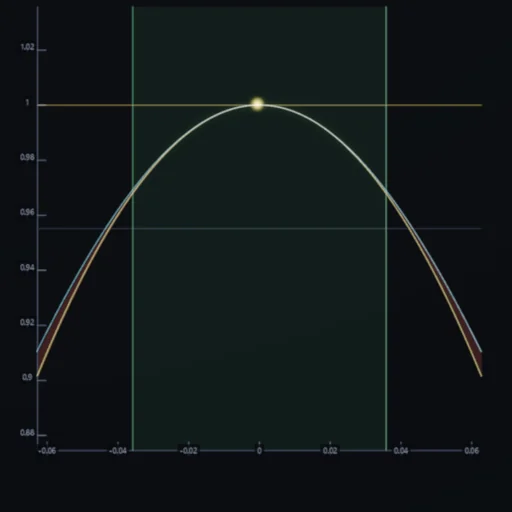
A Taylor polynomial is the best a function's derivatives at one point can say about it anywhere else. Near the point the statement is strong - the error falls like a power of the distance, one more with each degree - and the zoom shows it: each new term straightens the fit over a wider window. Far from the point the statement can fail entirely. 1/(1 + 25x²) is smooth on the whole real line and its series about 0 dies beyond |x| = 0.2, because the function has poles at ±i/5 that the real line never sees. Add terms, zoom, and watch the polynomial hug the curve inside the radius and fly away outside it.
Equations used in the module
Equations
T_n(x) = Σ_{k≤n} f^(k)(a)(x − a)^k/k!
remainder ~ |x − a|^{n+1} near the centre
radius of convergence = distance to the nearest singularity in the complex plane
1/(1 + 25x²): poles at ±i/5, R = 0.2 about 0
where more terms help (tail1303):  the widest interval about a on which |f − P_n| ≤ |f − P_(n−2)|, walked outward, a tie or a remainder under 4ε(|f| + Σ|c_k (x − a)^k|) counting as help
  1/(1 + 25x²) about 0: ±0.2 = R at n = 12 and at n = 24;  about 0.4: [0.144, 1.56] at n = 12, [−0.044, 0.844] ≈ a ± R = 0.4 ± 0.447 at n = 30 - helping now is not converging