MakarovSuites
English
EnglishDeutschРусскийУкраїнськаFrançaisEspañolItalianoPolski
Contact & licences

Math

Nets of the solids

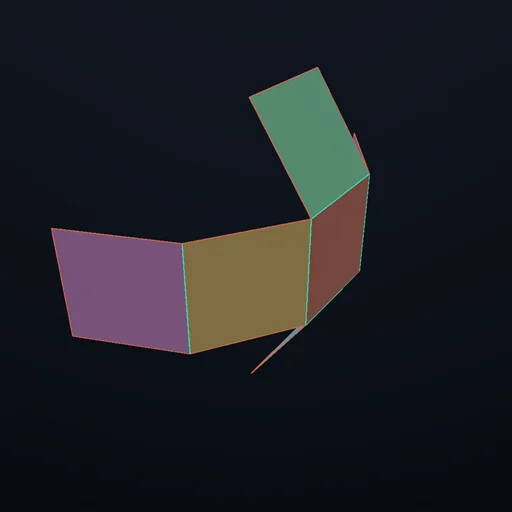
Cut a solid along some of its edges and open it flat. The uncut edges must keep every face connected without a loop - a spanning tree of the face graph - and every such tree is a net. The solid opens along its hinges by composed rotations, the net's area is checked against the surface, every pair of faces is clipped to prove nothing overlaps, and the nets are counted up to the solid's symmetries: two for the tetrahedron, eleven for the cube, eleven for its dual.
Nets of the solids — Actual application image
Actual application image

What happens

Cut a cube along seven of its twelve edges - the right seven - and it opens flat into one of eleven nets; the wrong seven leave two pieces or a loop. The uncut edges must form a spanning tree of the faces, and every spanning tree is a net, though some overlap themselves when laid flat. The unfolding is a hinge motion: each face swings about the edge it shares with its parent until the dihedral angle is gone. The cube has eleven nets, the icosahedron forty-three thousand. Pick a solid, choose which edges to cut, and fold it open and closed.

Equations used in the module
Equations
a net: the uncut edges form a spanning tree of the faces
unfolding: each face turns about its shared edge by π − dihedral angle
dihedrals: tetrahedron 70.5°, cube 90°, octahedron 109.5°, dodecahedron 116.6°, icosahedron 138.2°
nets of a cube: 11;  of an icosahedron: 43 380
Related experiments

Back to catalogue
Vertices, edges, faces — Actual application image

Math

Vertices, edges, faces

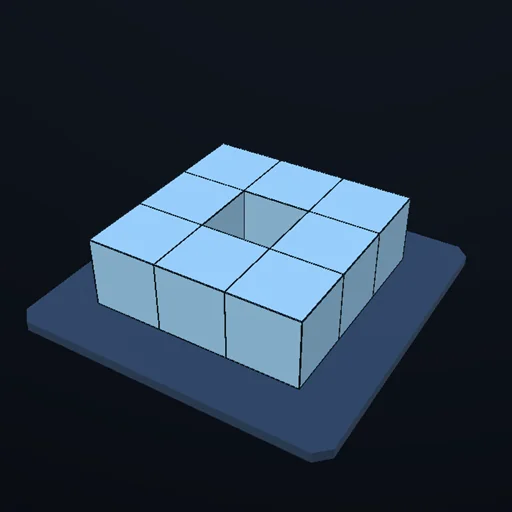
A solid body of a few dozen faces, and V − E + F read off it after every edit: triangulate a face, put a vertex in it, split or erase an edge, cut a face out, refine them all - a ledger shows what each does to V, E and F and that χ moves only when a hole is cut. The genus comes from χ with its conditions stated: how many pieces, how many boundary loops, orientable or not - on a Möbius band the formula gives cross-caps instead.

A 4D solid passing through — Actual application image

Math

A 4D solid passing through

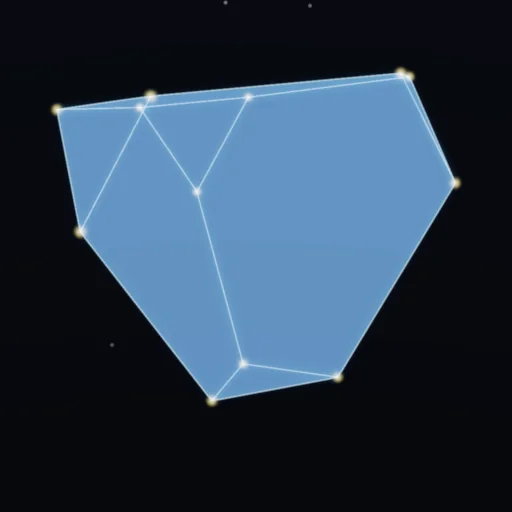
What a four-dimensional solid looks like from inside three-dimensional space: only its slice, and the slice changes as the solid moves through. A tesseract coming corner-first shows a tetrahedron that grows, loses its corners, becomes an octahedron and shrinks back; cell-first it shows one cube for the whole passage. The slices are built from the crossed cells, counted, measured, and their volume integrated over the passage is the 4-volume in every orientation - Cavalieri, one dimension up.

The Hopf fibration — Actual application image

Math

The Hopf fibration

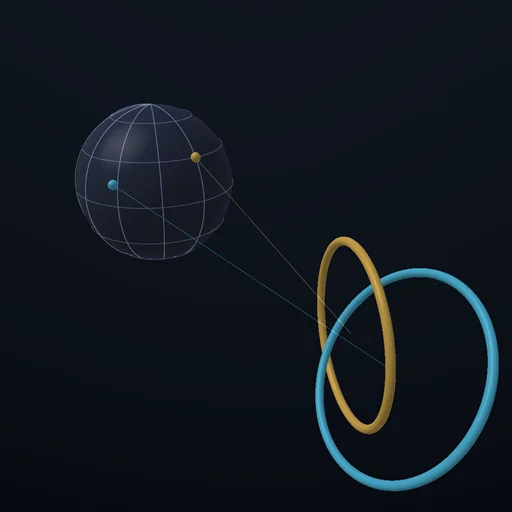
Every point of an ordinary sphere has a whole circle above it in the sphere of four dimensions, and those circles fill it without ever crossing - yet any two of them are linked, exactly once, however far apart their points are. Drag a point on the small globe and watch its circle move on the big picture; take a whole circle of latitude and the circles weave a torus. The linking number is measured by Gauss's integral, and the angle between two circles comes out at half the angle between their points - which is why a qubit's Bloch sphere has radius one half.