Math
The Hopf fibration
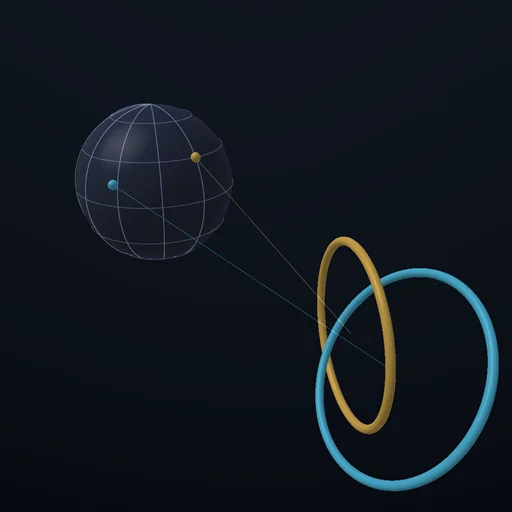
Every point of an ordinary sphere has a whole circle above it in the sphere of four dimensions, and those circles fill it without ever crossing - yet any two of them are linked, exactly once, however far apart their points are. Drag a point on the small globe and watch its circle move on the big picture; take a whole circle of latitude and the circles weave a torus. The linking number is measured by Gauss's integral, and the angle between two circles comes out at half the angle between their points - which is why a qubit's Bloch sphere has radius one half.
What happens
The three-sphere - the unit sphere in four dimensions - is made of circles, one for every point of an ordinary sphere, and no two of them touch: that is the Hopf fibration. Written in two complex numbers, multiplying both by the same phase moves a point along its circle and leaves its image on the ordinary sphere unchanged. Projected stereographically into our space the circles become circles again, nested in tori, and any two of them are linked exactly once. Move the point on the little sphere and watch its fibre; draw a whole circle of points and the fibres weave a torus.
Equations used in the module
Equations
h(z₁, z₂) = (2 Re(conj(z₁)z₂), 2 Im(conj(z₁)z₂), |z₁|² − |z₂|²),  |z₁|² + |z₂|² = 1
h(e^{iφ}z₁, e^{iφ}z₂) = h(z₁, z₂):  each fibre is a great circle
stereographic: (a, b, c, d) → (a, b, c)/(1 − d);  circles go to circles
any two fibres link once: lk = 1