MakarovSuites
English
EnglishDeutschРусскийУкраїнськаFrançaisEspañolItalianoPolski
Contact & licences

Math

Vertices, edges, faces

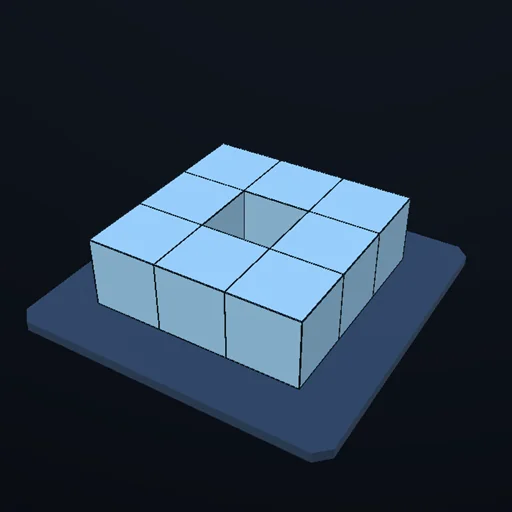
A solid body of a few dozen faces, and V − E + F read off it after every edit: triangulate a face, put a vertex in it, split or erase an edge, cut a face out, refine them all - a ledger shows what each does to V, E and F and that χ moves only when a hole is cut. The genus comes from χ with its conditions stated: how many pieces, how many boundary loops, orientable or not - on a Möbius band the formula gives cross-caps instead.
Vertices, edges, faces — Actual application image
Actual application image

What happens

Count the corners, edges and faces of a solid: V − E + F. On a block it is 2; drill a tunnel through it and the answer is 0; two tunnels, −2. The number does not care how the surface is cut into faces - triangulate a face, put a vertex in it, split an edge, erase one, refine everything, and V, E and F all move while their alternating sum stands still. Only cutting a face OUT changes it, by one. But χ alone is not the shape: the genus follows from it only once the pieces and the boundary loops are counted and the surface is orientable - a torus and a cylinder share χ = 0, and a Möbius band is neither.

Equations used in the module
Equations
χ = V − E + F
orientable, c pieces, b boundary loops:  χ = 2c − 2g − b
not orientable:  χ = 2c − k − b  (k cross-caps)
triangulate an n-gon: ΔE = ΔF = n − 3;  vertex in a face: ΔV = 1, ΔE = n, ΔF = n − 1
split an edge: ΔV = ΔE = 1;  erase an edge: ΔE = ΔF = −1;  cut a face out: ΔF = −1, Δχ = −1
Related experiments

Back to catalogue
A 4D solid passing through — Actual application image

Math

A 4D solid passing through

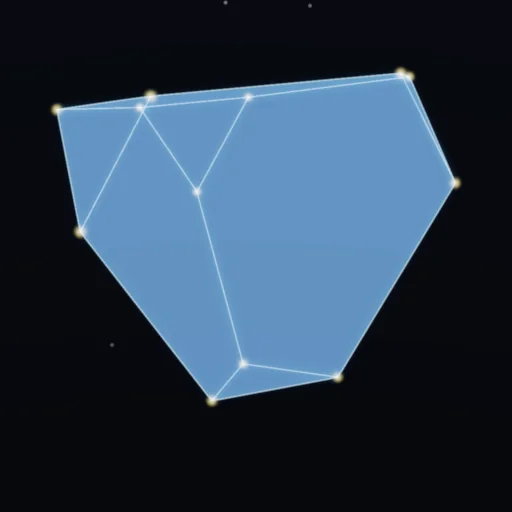
What a four-dimensional solid looks like from inside three-dimensional space: only its slice, and the slice changes as the solid moves through. A tesseract coming corner-first shows a tetrahedron that grows, loses its corners, becomes an octahedron and shrinks back; cell-first it shows one cube for the whole passage. The slices are built from the crossed cells, counted, measured, and their volume integrated over the passage is the 4-volume in every orientation - Cavalieri, one dimension up.

The Hopf fibration — Actual application image

Math

The Hopf fibration

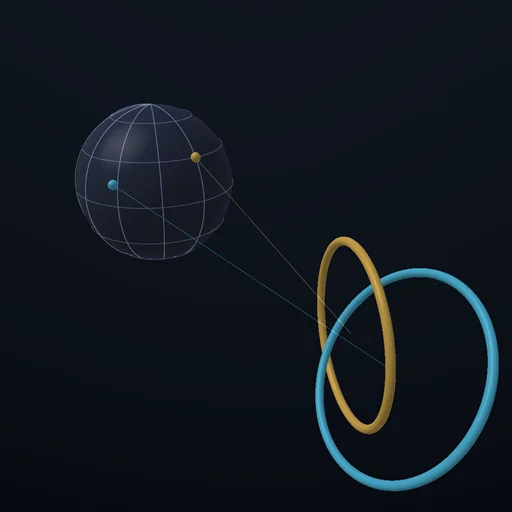
Every point of an ordinary sphere has a whole circle above it in the sphere of four dimensions, and those circles fill it without ever crossing - yet any two of them are linked, exactly once, however far apart their points are. Drag a point on the small globe and watch its circle move on the big picture; take a whole circle of latitude and the circles weave a torus. The linking number is measured by Gauss's integral, and the angle between two circles comes out at half the angle between their points - which is why a qubit's Bloch sphere has radius one half.

A curve that fills a square — Actual application image

Math

A curve that fills a square

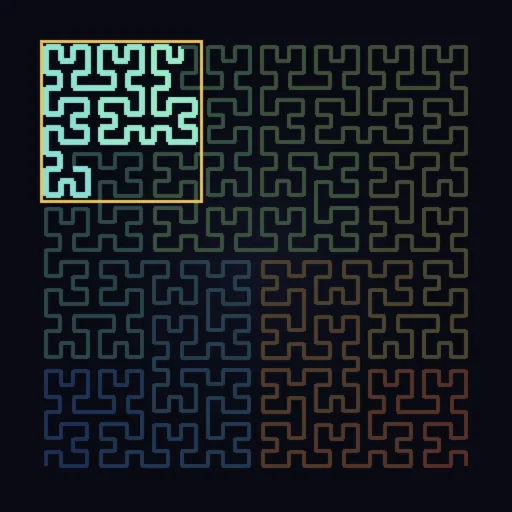
A line has no area, and yet a curve can pass through every point of a square - Peano found one in 1890, Hilbert drew his in 1891. At each order the curve visits every cell exactly once, moving one cell at a time, and the limit is continuous. Drag the marker: a tenth of the curve stays inside about a third of the side, which is why databases and image formats index space along this curve. The reverse is false, and the panel measures that too - two touching cells can be five sixths of the curve apart.