MakarovSuites
English
EnglishDeutschРусскийУкраїнськаFrançaisEspañolItalianoPolski
Contact & licences

Math

Pythagoras by area

Three ways to compare areas: wooden pieces, flexible sheets, and an exact top view.
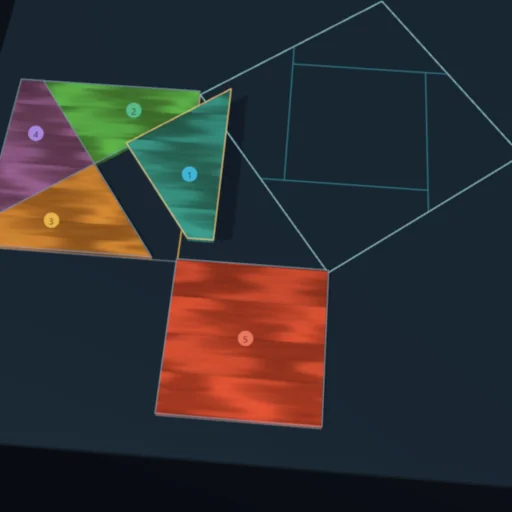
Pythagoras by area — Actual application image
Actual application image

What happens

First assemble Perigal yourself. Watch one transfer, then retry without outlines. Change a/b: can you make a² exactly 25% of c²? Each transfer pauses before lifting; the shared Pause button freezes it. Number and colour identify the same piece throughout. Coverage measures the union of the current projected polygons; grey inserts are included. Red marks overlap. Airborne motion is not a tiling. Decorative thickness contributes no area.

Equations used in the module
Equations
a² + b² = c²  as area: the two leg squares cut and moved fill the hypotenuse square
Perigal: two perpendicular cuts through the centre of the b-square, four pieces + the a-square
the cuts come from the Pythagorean tiling of the plane
measured: covered area = c², no overlap
Related experiments

Back to catalogue
Conic sections — Actual application image

Math

Conic sections

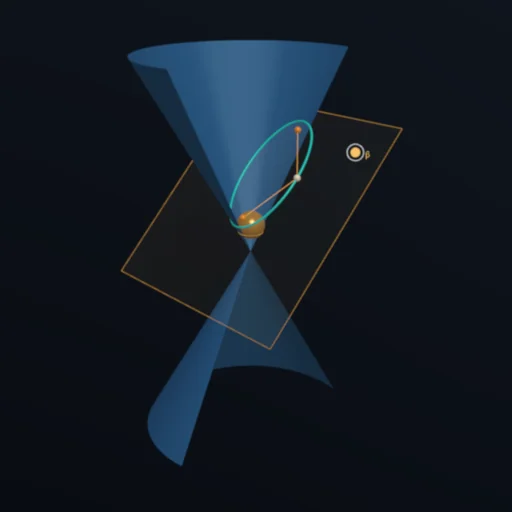
Drag the gold β handle to tilt the plane. Try each preset, then switch on the Dandelin spheres. Right drag rotates; the wheel zooms. The right view uses true distances in the cutting plane. The moving point measures the focus/directrix ratio e. A circle has e = 0 and no finite directrix. q describes the horizontal projection.

Nets of the solids — Actual application image

Math

Nets of the solids

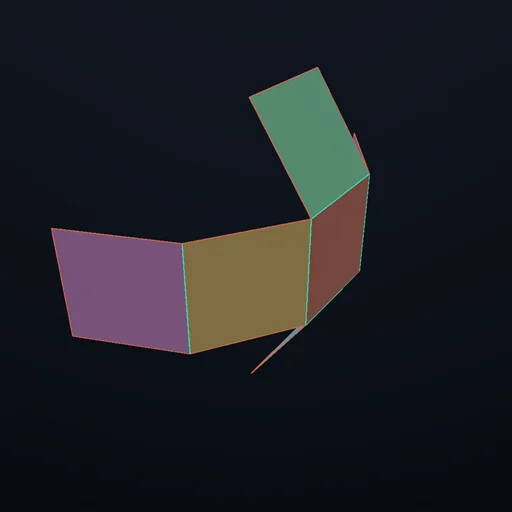
Cut a solid along some of its edges and open it flat. The uncut edges must keep every face connected without a loop - a spanning tree of the face graph - and every such tree is a net. The solid opens along its hinges by composed rotations, the net's area is checked against the surface, every pair of faces is clipped to prove nothing overlaps, and the nets are counted up to the solid's symmetries: two for the tetrahedron, eleven for the cube, eleven for its dual.

Vertices, edges, faces — Actual application image

Math

Vertices, edges, faces

A solid body of a few dozen faces, and V − E + F read off it after every edit: triangulate a face, put a vertex in it, split or erase an edge, cut a face out, refine them all - a ledger shows what each does to V, E and F and that χ moves only when a hole is cut. The genus comes from χ with its conditions stated: how many pieces, how many boundary loops, orientable or not - on a Möbius band the formula gives cross-caps instead.