Math
Slicing a surface
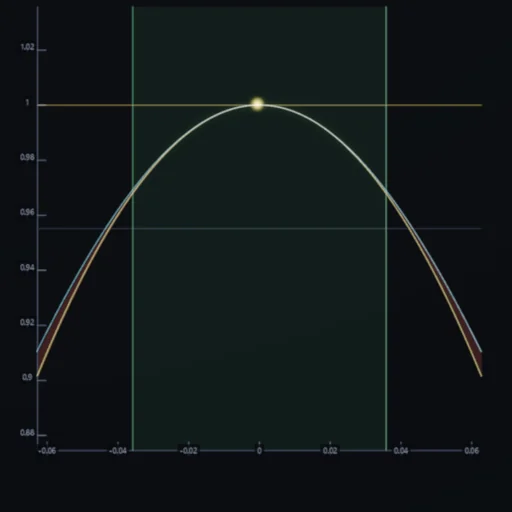
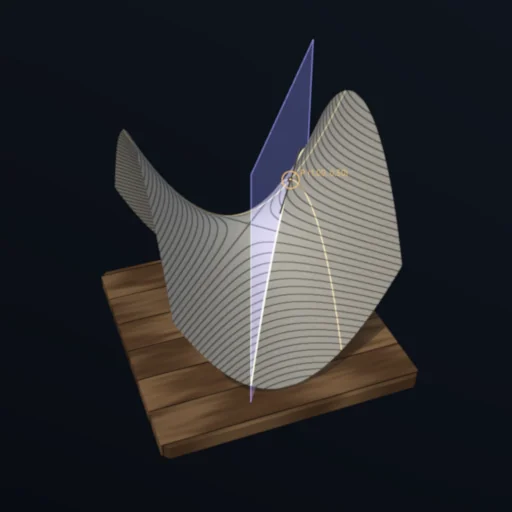
Cut a surface with a vertical plane and you get a curve; its slope is the derivative in that direction. Turn the plane and watch the slope change, then plot it in polar coordinates: for a differentiable surface that plot is exactly a circle with the gradient as its diameter, so the gradient being the steepest way up stops being a claim and becomes a picture. And one surface here has both partial derivatives, a directional derivative in every direction, and no tangent plane at all - the formula ∇f·u predicts zero while the surface climbs at 0.385, because existing is a weaker thing than differentiable.
What happens
Hold y still, walk along x, and a surface becomes a curve with an ordinary slope: that is a partial derivative, and there is one for each direction you refuse to move in. Walk in any other direction and the slope is the directional derivative; on a smooth surface it is the gradient dotted with the direction - but the formula carries two conditions. The direction must be a unit vector, and the surface must be differentiable, which is more than having partials: a cone has a directional derivative in every direction at its tip and the formula is wrong for all but two. Turn the direction, watch the slice and its slope, then try the cone.
Equations used in the module
Equations
f_x, f_y: slopes of the two axis-aligned slices
D_u f = lim (f(p + tu) − f(p))/t along unit u
D_u f = ∇f · u  - only for unit u and only where f is differentiable
the cone f = xy/√(x² + y²): every D_u exists at 0, the formula fails