Engineering
CNC milling machine
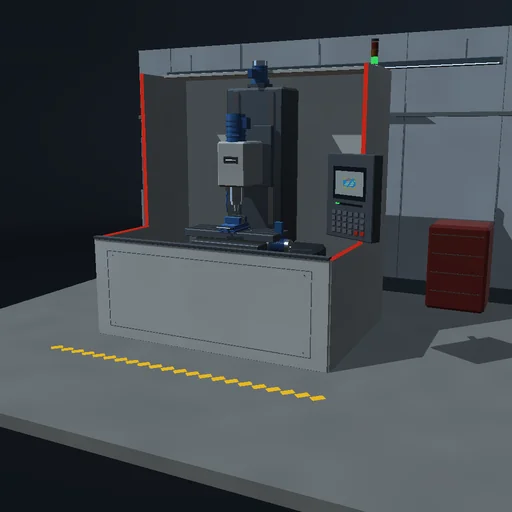
Mill a pocket into an aluminium block: the end mill slots down the middle and then runs loops out to the walls, driven by servo axes and a spindle of limited power. Compare a shallow and a deep pass, watch the engagement and the force jump in the corners, and lower the spindle's power until it slows or stalls, then switch on the adaptive feed.
What happens
A three-axis vertical machining centre mills a slot or a pocket of 60 × 36 mm into a block of aluminium (EN AW-6082) of 100 × 60 × 30 mm, entering through a pilot hole. A 10 mm end mill with three teeth turns at 6000 rpm and moves at 900 mm/min, 0.05 mm per tooth, 4 mm deep. Each tooth cuts a chip f_z·sin φ thick over the arc of the tool that meets material, found from a map of 1 mm cells that keeps what the tool has swept; Kienzle's law, 650 N/mm² with the exponent 0.25, gives the force, averaged over a tooth period. Servo axes follow the program with a lag of v/K_v and stop at every corner; the spindle's drive is limited to its power above 1500 rpm and to the matching torque below.
In the slot the whole front half of the tool cuts: 180°, 1.42 N·m on the spindle and 230 N on the tool, 600 mm³/s at 1.49 J/mm³, so the spindle draws 1.00 kW, 110 W of it in its bearings. A pass 2 mm deep needs 0.71 N·m, one 8 mm deep four times as much. Along the pocket's walls, 4 mm apart, the tool engages 78.5° and needs 0.58 N·m; running into an inside corner it meets the end wall too, the engagement jumps to 168.5° and the force climbs to the slot's 230 N. The finishing loop, 1 mm, engages 36.9°, and 126.9° in its corners. The pocket removes 8.02 cm³. Cut the spindle's power to 0.75 kW in the slot and, at a held feed, it slows to 5090 rpm in a second and to 3662 rpm in three, heading for 2545 rpm while the chip grows to 0.08 mm; below 646 W it cannot hold its base speed: at 0.5 kW it stalls after 2.15 s and the control stops. The adaptive feed holds the spindle instead by slowing the slot to 260 mm/min.
Model: cutting forces averaged over a tooth period, straight teeth, the radial force 0.35 of the tangential, the specific force no longer growing below a chip of 10 µm; one depth per run; no tool deflection, wear, chatter, heat or chips in the cut. Whether a point is still material is decided by exact distances to the swept tool's paths named by the map's nodes. RK4 in steps of 1 ms; the journal closes on the motors' work: cutting, bearings, guideways and the stored kinetic energy.
Try this
Watch the slot and then the loops: the engagement and the spindle's power jump in every corner. Try a deeper pass, then lower the power limit until the spindle slows or stalls, and switch on the adaptive feed.
Equations used in the module
Equations
f_z = v_f/(z·n),  h(φ) = f_z·sin φ
F_t = k_c1.1·a_p·h·(h/1 mm)^(−m_c),  F_r = 0.35·F_t
T = z/(2π)·R·∫F_t dφ  (φ_in ≤ φ ≤ φ_out),  φ_e = acos(1 − 2a_e/D)
Q = a_p·a_e·v_f,  P = T·ω ≤ P_max
J·dω/dt = T_motor − T − T_bearings