Physics / Astronomy / Earth
Coriolis on a rotating Earth
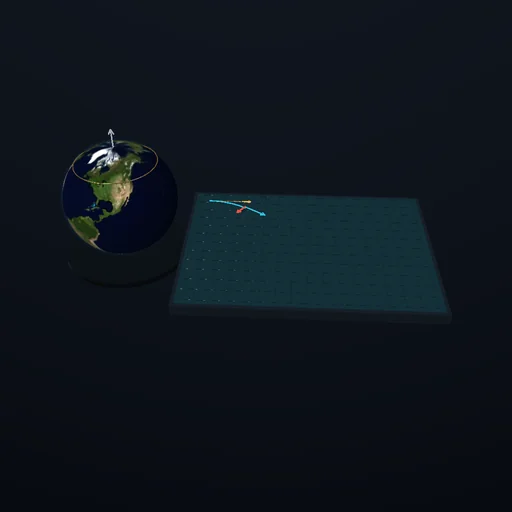
A free particle over a rotating planet: the Coriolis force alone curls a straight shot into a circle.
What happens
Launch a particle eastward in a local tangent-plane model. With only Coriolis acceleration, it follows an inertial circle of radius v/|f|, where f = 2Ω sin φ. North of the equator it turns right; south it turns left. At the equator f = 0 and it travels straight. Compare with the no-rotation reference. The globe displays the local solution; it is not a global atmospheric trajectory calculation. One playback second represents one model hour.
Try this
T = T_sidereal / (2 sin φ): one day at sin φ ≈ 0.50, i.e. 30° - not at the pole, where it is 12 h.
Equations used in the module
Equations
f = 2Ω sin φ; a_x = f v_y; a_y = −f v_x
r = v/|f|; T = 2π/|f|
X = (v/f)sin(ft); Y = −(v/f)(1−cos(ft))
f = 0: X = vt; Y = 0