MakarovSuites
English
EnglishDeutschРусскийУкраїнськаFrançaisEspañolItalianoPolski
Contact & licences

Astronomy

Finding your position from orbit

Locate a receiver using six satellite pseudoranges. Add clock error and range noise, then compare a spread-out constellation with poor geometry.
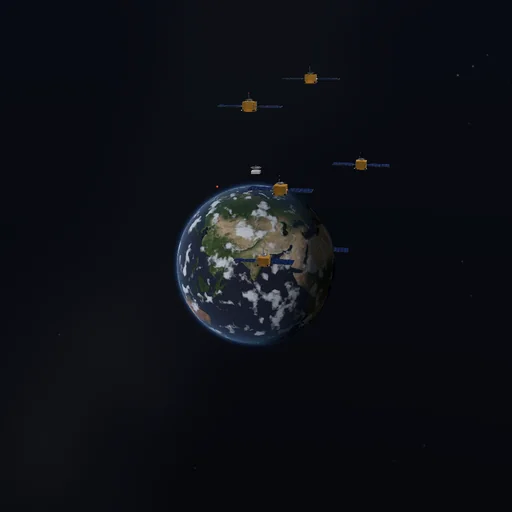
Finding your position from orbit — Actual application image
Actual application image

The model and its limits

Synthetic constellation at the real scale (six satellites on the 26 560 km sphere, the receiver on the ground); Gauss-Newton solves three position coordinates plus clock bias, GDOP from the normal matrix. Range noise is a deterministic Gaussian. No real GNSS ephemerides, ionosphere or relativity corrections. The scene shows satellite directions, not distances; the error marker is enlarged and capped.

Equations used in the module
Equations
rho_i = |r_i-r_receiver| + c delta_t + noise_i; delta_x = (J^T J)^(-1) J^T residual; c = 299792458 m/s
Related experiments

Back to catalogue
Avoiding an orbital collision — Actual application image

Astronomy

Avoiding an orbital collision

Watch a predicted conjunction and make an avoidance burn. Measure the actual closest approach and compare it with an unpowered pass.

Two spacecraft on a tether — Actual application image

Astronomy

Two spacecraft on a tether

Deploy a tether between two spacecraft. Watch gravity-gradient libration and see how reeling changes the angular motion and tension.

Working on a tiny world — Actual application image

Astronomy / Engineering

Working on a tiny world

Operate a drill where gravity is extremely weak. Anchor the machine before drilling, then release it and see the reaction push the rig away.