Physics / Astronomy
Kepler problem
Motion in a central gravity field: ellipses and Kepler's laws.
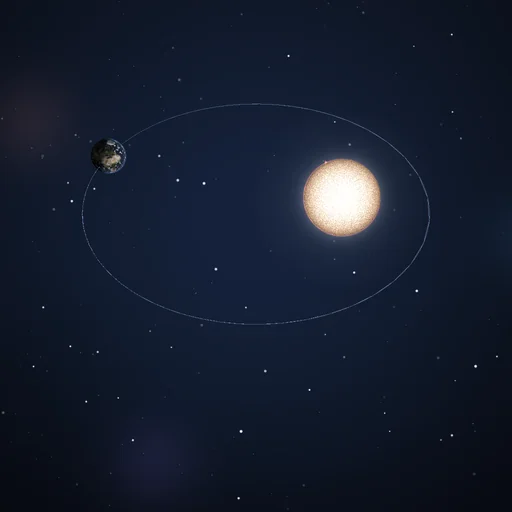
What happens
A planet in the gravity of its star: the orbit is an ellipse with the star in a focus, and near it the planet visibly speeds up, sweeping equal areas in equal times. Raise the eccentricity to stretch the ellipse and sharpen the rush through perihelion; the r(t) and v(t) charts breathe in step, and the period follows Kepler's third law.
Try this
Only a matters: T² = a³, so a = 2^(2/3) = 1.587 AU whatever the eccentricity. Try a large e first and see that the period does not move.
Equations used in the module
Equations
a_r = −μ/r² − β/r³; μ = GM
E/m = v²/2 − μ/r − β/(2r²)
β = 0: r = a(1−e²)/(1+e cos ν)
β = 0: T² = 4π²a³/μ; v² = μ(2/r−1/a)
oblateness: a = −(3/2) μ J₂R²/r⁵ [(1 − 5z²/r²) x, (1 − 5z²/r²) y, (3 − 5z²/r²) z];  ΔΩ = −3π J₂R² cos i/(a²(1 − e²)²) per orbit
relativity: a = B μ/(c²r³) [(4μ/r − v²) r + 4 (r·v) v];  Δω = 6π μ B/(c² a (1 − e²)) per orbit;  μ = 4π² M