Math
Minimal surfaces
Catenoid, helicoid, Enneper, Scherk, Schwarz P and the gyroid: the shapes a soap film settles into.
What happens
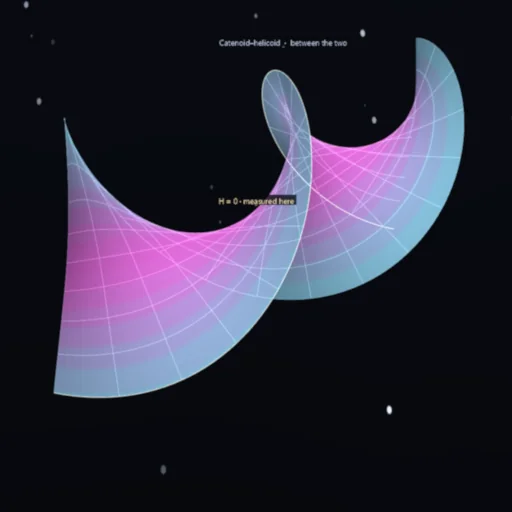
A soap film pulls itself as small as it can, and the shape it settles into has mean curvature zero at every point: bent one way exactly as much as the other. Four of these surfaces come from Weierstrass data, and turning the Bonnet angle θ carries each through its associate family without a single stretch - the catenoid rolls itself into the helicoid at θ = π/2 with every distance on the film unchanged, and the panel measures H at a point on the surface, live, and it stays at zero. Colour is Gauss curvature, cyan where the film is nearly flat and magenta where the saddle is sharpest. Schwarz P and the gyroid are cut from their level sets by marching tetrahedra; those are the textbook approximations, and the panel prints how far they miss H = 0.
Equations used in the module
Equations
H = (κ₁ + κ₂)/2 = 0   (minimal: the mean curvature vanishes everywhere)
X(ζ) = Re( e^(iθ) ∫ ( f(1 − g²)/2,  i f(1 + g²)/2,  f g ) dζ )   (Weierstrass–Enneper)
catenoid → helicoid:  θ from 0 to π/2, with E, F, G unchanged   (Bonnet, an isometry)
Enneper:  x = Re(ζ − ζ³/3),  y = Re(i(ζ + ζ³/3)),  z = Re(ζ²)
Scherk:  z = ln(cos y / cos x);   gyroid ≈ sin x cos y + sin y cos z + sin z cos x = 0