Math
Möbius strip
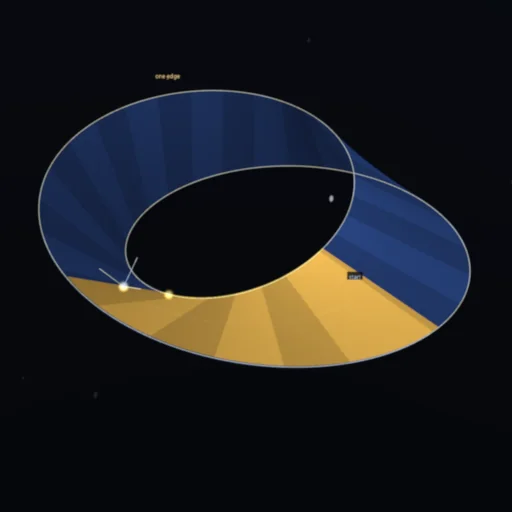
One side, one edge, and an ant that comes back mirrored: it paints the band as it walks the core, and after one lap on the Möbius strip it is painting what looked like the other side.
What happens
A band with k half-twists hangs in space; k = 1 is the Möbius strip. It is drawn as two skins a hair apart, one on each side of the surface, so that the two sides can be painted differently - and a flat ant walks the core with a brush, painting the skin it stands on. On the Möbius strip the ant is on the other skin after one lap, without ever leaving the surface, and after two laps both skins are painted: the "two" sides were one. On a band with an even number of half-twists the second skin stays bare for ever. The ant carries a forward arrow, a left arrow and an up arrow; after one lap on an odd band forward is the same and left points the other way - it has been mirrored, and the panel prints the determinant of its frame, −1. The edge glows as its own curve: one curve of two laps for odd k, two curves for even, with a runner going round. The panel counts sides and edges off a mesh of the band, not off k: it tries to orient every patch consistently (that fails exactly when the surface is one-sided) and joins the boundary edges into curves. A cut along the core leaves ONE piece twice as long and two-sided; a cut a third of the way in leaves a thinner Möbius strip and a two-sided band, and the Gauss integral says they are linked once. The curvature at the ant is measured too: negative everywhere, −(k/2)² on the core - this strip is bent, a paper one is flat.
Equations used in the module
Equations
P(u, v) = ((R + v·cos(ku/2))·cos u, (R + v·cos(ku/2))·sin u, v·sin(ku/2)),  u in [0, 2π),  v in [−w, w],  k half-twists  (k = 1: Möbius)
seam:  P(u + 2π, v) = P(u, (−1)^k·v);   normal after one lap:  N(2π) = (−1)^k·N(0)
flat ant carrying (forward, left):  forward → forward,  left → (−1)^k·left  - determinant (−1)^k, mirrored for odd k
edge v = w:  closes after 4π for odd k (ONE edge), after 2π for even k (two edges);  χ = V − E + F = 0 for every k
cut along the core:  odd k → one two-sided band (twice round),  even k → two bands;  cut at w/3 on the Möbius strip → a thinner Möbius strip + a two-sided band, linked once
Gauss linking:  |Lk(edge, core)| = k for odd k;  k/2 for each edge when k is even
Gauss curvature on the core line:  K = −(k/2)²/R²  (−1/4 for the Möbius strip; the parametrised strip is not flat, paper is)