Math
Hyperbolic geometry
The Poincaré disc and the hyperboloid: tilings that never run out of room, sliding by isometries.
What happens
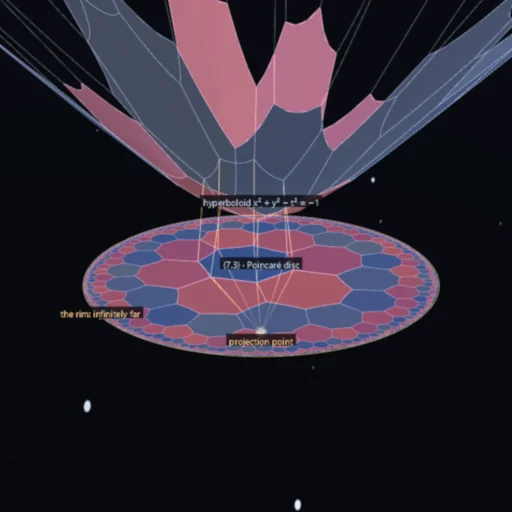
On the floor, the Poincaré disc: the whole hyperbolic plane inside a circle, with the rim infinitely far away. A regular p-gon with q at every corner tiles it whenever 1/p + 1/q < 1/2 - {7,3}, {5,4}, {4,5}, {3,7} - and the tiling here is built by reflecting the central tile across its edges, nothing placed by hand. Every tile has the same area, the angle defect (p − 2)π − 2πp/q, and the tiles per layer grow geometrically: that is curvature −1. The tiling flows: a Möbius translation slides it, tiles rising from the rim and sinking back, and no edge ever changes its hyperbolic length. Above, the same tiles lifted onto the hyperboloid x² + y² − t² = −1 - the same plane, another model - with lines from the projection point joining a tile to its lift.
Equations used in the module
Equations
{p, q} tiles the hyperbolic plane when 1/p + 1/q is below 1/2   (equal: Euclidean; above: spherical)
cosh R = cot(π/p) · cot(π/q)   (circumradius of a tile)
area = (p − 2)π − 2πp/q   (the angle defect; curvature −1)
d(z, w) = 2 artanh |(z − w) / (1 − conj(z) w)|;   z → (z − a)/(1 − conj(a) z) keeps it
hyperboloid:  x² + y² − t² = −1,  d = acosh(t t′ − x x′ − y y′)