Earth
Permafrost and thaw
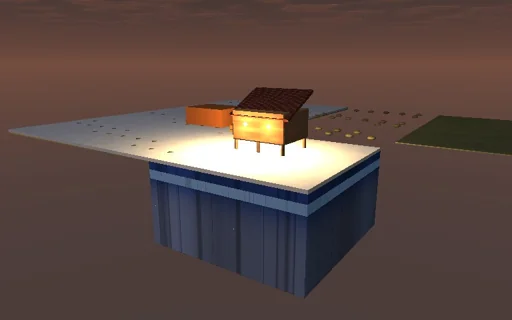
Watch the ground under a tundra house through the seasons: each summer the top thaws to the depth of the active layer, each winter it freezes again, and below the ground stays frozen at the melting point of its ice. A thick snow cover keeps the winter cold out and the ground five degrees warmer; scrape it away and the permafrost hardens. Warm the climate by a degree a decade and the active layer deepens year by year until the ice-rich layer thaws and the house settles by its excess ice. The latent heat of the ice holds the thaw front back exactly as Neumann’s solution says, and the heat that crossed the surface and the base is the enthalpy the column gained.
What happens
A soil column 15 m deep in 75 cells, 35 % water with an ice-rich layer of 70 % between 1.5 and 3 m. Each cell holds its enthalpy relative to frozen ground at 0 °C: below zero it is frozen, between zero and the latent heat of its water a mixture at 0 °C, above that thawed; conduction uses harmonic means of the frozen and thawed conductivities. The air (−6 °C mean, ±18 °C, a warming trend) drives the top through 0.3 m of snow in winter; 60 mW/m² of the Earth’s heat enters the base. The excess ice settles the first time it thaws. Explicit steps of 3 h; the heat through the top and base equals the enthalpy gained, and Neumann’s solution checks the thaw front.
Try this
Watch a year’s thaw and freeze; scrape the snow away or deepen it; warm the climate by a degree a decade and wait for the house to settle; switch off the latent heat and see how fast the front runs.
The model and its limits
One-dimensional conduction, a sharp freezing point, fixed soil properties, no water migration, frost heave or vegetation; settlement is a stated bookkeeping of excess ice. Depths are those of this idealized column.
Equations used in the module
Equations
H = C_f·T (T < 0),  0…L (T = 0),  L + C_u·T (T > 0)
dH/dt = ∂/∂z(k·∂T/∂z),  q0 = (T_air − T1)/(R_snow + Δz/2k)
X(t) = 2λ·√(α·t),  λ·e^(λ²)·erf λ = St/√π
ΔH_column = ∫q0 dt + ∫q_geo dt,  s = Σ(w_ice − w)·Δz