Earth
Waves shape a coastline
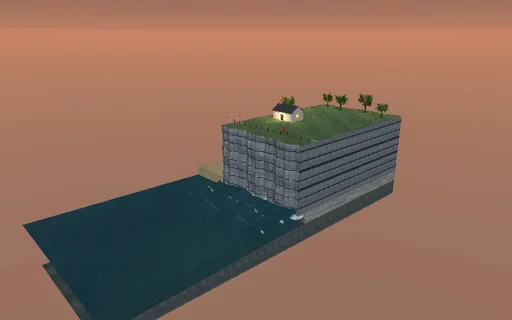
Watch a century go by on a white chalk headland under a grey, windy sky. The breakers cut a notch at the foot wherever their force beats the rock’s resistance; the overhang above hangs like a cantilever until the tension at its root reaches the strength of the chalk, and then the whole block comes down. Its talus shelters the foot until the waves wear it away, and only then does the next notch grow, so the edge steps back a few metres at a time at the closed-form mean rate of that cycle - past the coast path, the fence and, one day, the cottage. Make the waves higher, the chalk weaker or stronger, add a harder band or a seawall; raise the sea and bigger waves reach the foot, while the sandy cove beside it moves its shoreline back by the sand balance and Bruun’s rule. The rock lost balances the notch, the talus worn and the talus left.
What happens
A chalk cliff 20 m high above its shore platform, in profile, in metres and years. Waves of 1.8 m break at the foot, at most 0.78 of the water depth there (2.5 m plus the sea’s rise of 4 mm a year). Their force ρ_w·g·H_b against the rock’s resistance A·σ_c (A = 0.002, chalk 5 MPa) cuts a notch 3 m high at Sunamura’s rate K·ln(F/F_r), K = 1 m/yr - 0.59 m/yr - slowed by e^(−V/15 m²) while talus of area V lies at the toe. The overhang above the notch, 17 m thick, is a cantilever whose root carries the tensile stress 3·ρ_r·g·n²/T (ρ_r = 2000 kg/m³); at the rock mass’s strength of 40 kPa, the closed-form depth n_c = √(σ_t·T/(3·ρ_r·g)) = 3.40 m, the block n_c·T = 57.8 m² per metre of coast falls and becomes talus, worn away at 6·H_b² m²/yr scaled by 5 MPa/σ. Within each sub-step of 0.01 yr the talus falls linearly, so the notch growth is integrated exactly, and the collapse is found by bisection inside it. Steady cycle: talus time V_b/w = 2.97 yr, a sheltered notch of 0.45 m, then open growth: 7.95 yr per 3.40 m, 0.43 m/yr. A harder band from 21 to 30 m multiplies the resistance and the talus’s toughness by 1.6; a seawall stops the notch. Ledgers: rock lost = notch rock carried off + talus made; talus made = talus worn + talus left. The sandy cove beside the headland (berm 2.5 m, closure depth 3.5 m at 40 m) answers the rise S by the sand balance of its Dean profile moved up S and back R: exactly R = S·L/(B + h − S); Bruun’s rule drops the S below the line. One second is a year at time scale 1; the run ends at 150 years or when the edge has gone 36 m.
Try this
Watch the notch deepen to the critical depth, the block fall and the talus shelter the foot until the waves wear it away; compare the mean retreat with the steady cycle; make the waves higher or the chalk stronger, add the harder band or a seawall; raise the sea and watch bigger waves reach the foot and the cove’s shoreline move back.
The model and its limits
A two-dimensional profile with one effective wave height, a rectangular notch at a fixed level, collapse of the whole overhang by bending alone, and a platform that keeps its depth as the cliff retreats; the cove follows the rigid-shift sand balance. Rates and numbers belong to this idealized chalk coast.
Equations used in the module
Equations
dn/dt = K·ln(F/F_r)·e^(−V/V_p),  F = ρ_w·g·H_b,  F_r = A·σ_c,  H_b = min(H, 0.78·(d0 + S))
σ_root = 3·ρ_r·g·n²/T = σ_t  →  n_c = √(σ_t·T/(3·ρ_r·g)),  block n_c·T → talus,  dV/dt = −C_t·H_b²·σ_ref/σ
cycle = V_b/w + (n_c − r·V_p/w·(1 − e^(−V_b/V_p)))/r,  mean retreat = n_c/cycle
cove: R·(B + h − S) = S·L,  Bruun: R = S·L/(B + h)