Engineering
Phonograph: sound in a groove
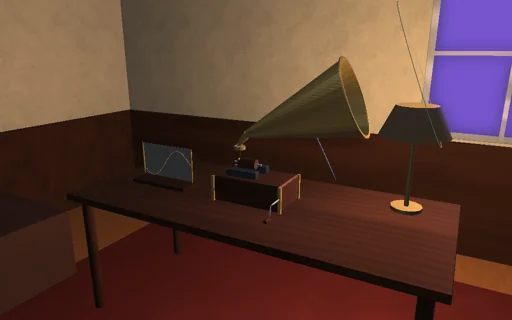
Play a wax cylinder in a lamp-lit parlour: the hill-and-dale groove lifts a stylus tip that drives the mica diaphragm through its lever spring, and the horn turns the diaphragm’s motion into sound. Watch the groove magnified two thousand times beside the machine and the stylus riding it; raise the tone past the closed-form mistracking frequency and the tip flies off the hills; speed the cylinder up and the pitch rises in proportion; load the diaphragm with a better horn and it radiates more. The groove work is booked against every loss and the sound radiated.
What happens
A wax cylinder turns at 160 rpm under a stylus tip of 0.3 g pressed down by 0.3 N; a stiff unilateral contact spring with damping lets the groove push the tip up but never pull it down. The tip drives the 0.5 g mica diaphragm through the stylus lever spring; the diaphragm sits on its own suspension and the horn loads it with a radiation resistance whose dissipation is the sound. RK4 at 2 µs; the groove work, every loss and the radiated sound are integrated with the same weights, so the ledger closes. The closed-form linear response gives the amplitudes and the frequency at which the dynamic contact force first equals the tracking force.
Try this
Play the 440 Hz tone and compare the amplitudes with the closed form; raise the tone past the mistracking frequency and watch the tip leave the groove; speed the cylinder up; load the horn.
The model and its limits
One-dimensional hill-and-dale groove, point stylus, linear lever and suspension, the horn as a single radiation resistance; no groove wear, no acoustic resonances of the horn. Levels are those of this idealized reproducer.
Equations used in the module
Equations
N = k_c·(g − y1) + c_c·d(g − y1)/dt,  N ≥ 0
m1·a1 = N − F_t − k_l·(y1 − y2) − c_l·(v1 − v2)
m2·a2 = k_l·(y1 − y2) + c_l·(v1 − v2) − k2·y2 − (R_h + c_0)·v2
W_groove = ΔE + ∫(c_l·Δv² + c2·v2² + N_loss) dt,  P_sound = R_h·v2²