MakarovSuites
English
EnglishDeutschРусскийУкраїнськаFrançaisEspañolItalianoPolski
Contact & licences

Math

Tangent circles

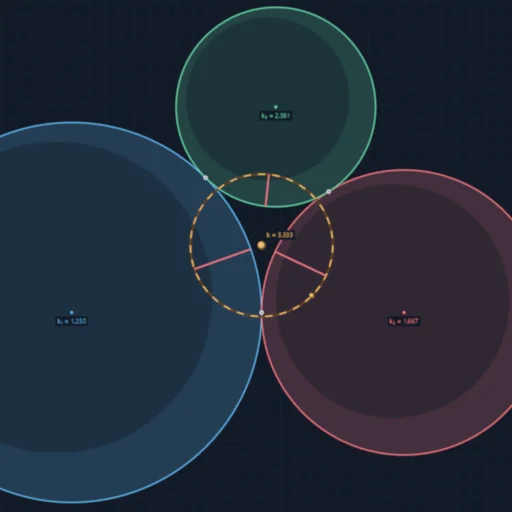
Fit a fourth disc between three touching discs until it touches all of them, with the narrowest gap magnified; compare its curvature with Descartes' relation, then find the second solution - an enclosing circle, a line or an outside circle - and grow the Apollonian packing.
Tangent circles — Actual application image
Actual application image

What happens

Three discs touch in pairs. Which circle touches all three? Fit a brass ring into the middle: move it, pull its rim, fine-tune with the wheel; the inset magnifies the worst gap. Curvature k = 1/r decides the size: Descartes' relation ties the four curvatures together and gives two answers. The second is signed - negative for a circle that encloses the three, zero for a straight line, positive for a circle outside them. Repeating the construction in every new gap grows the Apollonian packing.

Equations used in the module
Equations
k = 1/r;   (k₁+k₂+k₃+k₄)² = 2(k₁²+k₂²+k₃²+k₄²)
k₄ = k₁+k₂+k₃ ± 2√(k₁k₂+k₂k₃+k₃k₁)
+ :  the inner circle, k₄ > 0
− :  k₄ < 0 encloses the three,  k₄ = 0 a line,  k₄ > 0 a circle outside
packing:  k' = 2(k₁+k₂+k₃) − k₄,   k'z' = 2(k₁z₁+k₂z₂+k₃z₃) − k₄z₄
Related experiments

Back to catalogue
The isoperimetric problem — Actual application image

Math

The isoperimetric problem

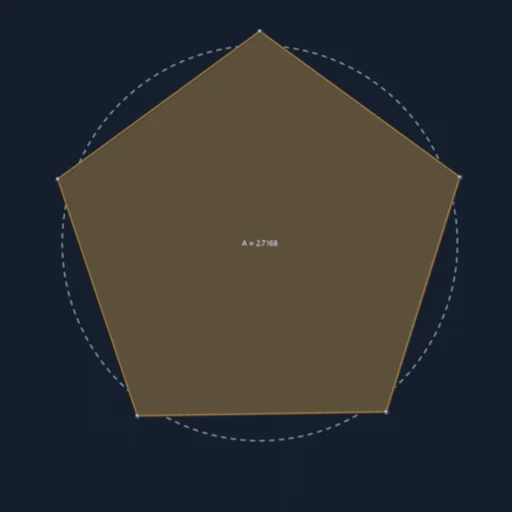
One cord of fixed length on pins: add sides and watch the enclosed area grow toward the circle's while a ruler shows the cord is still the same length; then predict which of two shapes from the same cord holds more, and check.

Circle packing — Actual application image

Math

Circle packing

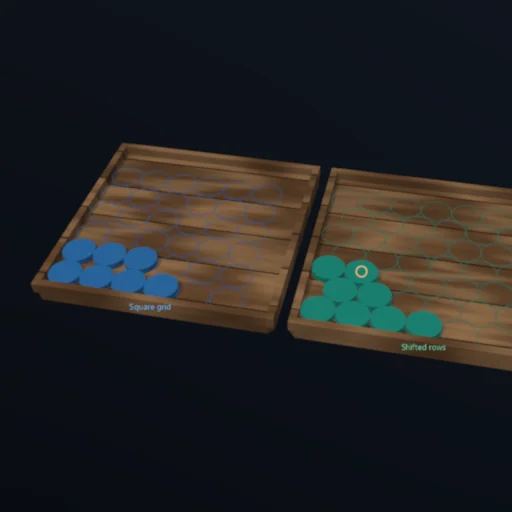
Compare square and staggered lattices in finite squares. Counts include only discs entirely inside the boundary. The infinite-lattice density is a reference, not a claim of optimal finite packing.

Equal-area dissection — Actual application image

Math

Equal-area dissection

Drag piece 2 onto its target on the right. Both pieces can be moved in the scene or in the exact top view. A₁ + A₂ = b·h, b = 2. Bevels and flight height are decorative. Overlap, unfilled target and outside area are calculated from the exact polygons; equal total area alone does not prove coverage.