Math
The primes from the zeros of zeta
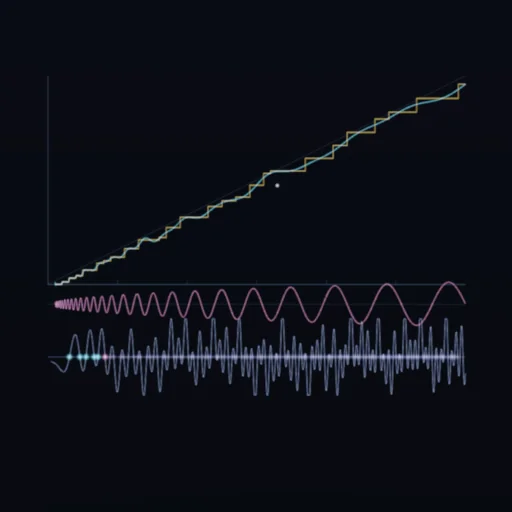
Riemann's explicit formula: the prime staircase is a sum of waves, one per zero of the zeta function. Add the zeros one at a time and watch a straight line ripple into the primes, each step at a prime power and ln p tall. The critical line underneath, the first 120 zeros as data, the residual against the sieve measured per zero.
What happens
Count the primes with a weight: Chebyshev's ψ(x) climbs by ln p at every prime power p, p², p³ - a staircase, gold, exact, from a sieve. Riemann found that the same staircase is a sum of waves. Start from the plain line x − ln 2π; for every zero ρ = ½ + iγ of the zeta function subtract the wave 2√x·(cos(γ ln x)/2 + γ sin(γ ln x))/(¼ + γ²), and the line tilts and ripples. Add more zeros and the ripples organise themselves into steps - at exactly the prime powers, each exactly ln p tall - because the formula is not an approximation but an identity: with every zero in, it IS the staircase. Watch it happen. The scene lays the zeros in one at a time, the newest wave drawn on its own beneath the plot so you can see what each one contributes: the first zero, γ = 14.13, is the longest, slowest ripple; the hundredth is a fine tremor. The cyan line's RMS distance from the staircase, measured on 980 points off the jumps, falls from 1.57 with no zeros to 0.46 with a hundred and twenty - slowly, because each wave shrinks only like 1/γ, and that slowness is the deepest fact on the screen: how close the primes sit to a smooth line is decided by where the zeros are. Riemann's hypothesis says they all lie on the line ½ + it; the lower strip draws that line, Z(t), with the table's zeros as dots at its sign changes. The zeros come from a twenty-digit computation; the line is drawn by the Riemann–Siegel formula, which the module measured at a hundredth of the truth and says so. How many zeros up to T? Riemann counted them too: T/2π·ln(T/2πe) + 7/8 - 119.5 at the hundred-and-twentieth, off by half, the half being what nobody has tamed.
Equations used in the module
Equations
staircase:  ψ(x) = Σ_{p^k ≤ x} ln p   (Chebyshev; from a sieve to 400)
explicit formula:  ψ₀(x) = x − Σ_ρ x^ρ/ρ − ln 2π − ½ ln(1 − 1/x²),  ρ = ½ + iγ over both halves of the strip
one zero's wave:  2 Re(x^ρ/ρ) = 2√x·(cos(γ ln x)/2 + γ sin(γ ln x))/(¼ + γ²);  amplitude 2√x/|ρ|
zeros:  γ₁ = 14.134725, γ₂ = 21.022040, γ₃ = 25.010858 … γ₁₂₀ = 269.970449  (mpmath, 20 digits, |ζ(½ + iγ)| below 1e-13)
residual:  RMS of ψ_N − ψ on 980 points of [2, 100]:  N = 0: 1.571,  10: 0.990,  50: 0.641,  120: 0.456
steps:  ψ₁₂₀ climbs 1.910 across x = 7 (ln 7 = 1.946), 0.723 across 8 (ln 2 = 0.693), 0.042 across 6 (no prime power)
critical line:  Z(t) = 2 Σ_{n ≤ √(t/2π)} n^{−½} cos(θ(t) − t ln n) + (−1)^{N−1} (t/2π)^{−¼} C₀(p),  θ(t) = t/2·ln(t/2π) − t/2 − π/8 + 1/48t + 7/5760t³
Z accuracy (measured):  1.1e-2 on [10, 100], 3.8e-3 on [100, 250];  |Z| at the table zeros ≤ 1.1e-2
count:  N(T) = T/2π·ln(T/2πe) + 7/8:  119.48 at γ₁₂₀, the rest is S(T)