MakarovSuites
English
EnglishDeutschРусскийУкраїнськаFrançaisEspañolItalianoPolski
Contact & licences

Math

The integral, built by hand

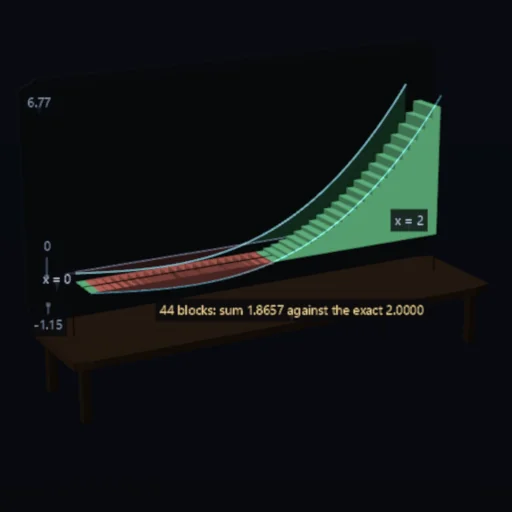
Fill the region under a curve with panels and watch the count climb: the choice of where each panel takes its height decides everything, and the trapezoid that follows the curve is exactly twice as bad as the midpoint rectangle that does not. Then the sign, because the integral of a sine over one period is zero while the area between it and the axis is four. And the accumulated function, whose slope is the curve you started from - except where the curve jumps, and there it has a corner instead.
The integral, built by hand — Actual application image
Actual application image

What happens

Cut the interval into strips, put a height on each, add - that is an integral before any rule for antiderivatives, and this panel builds it strip by strip. Left and right heights err in proportion to the strip width; midpoint and trapezoid err as its square, in opposite directions, so the truth is bracketed between them; two parts midpoint to one part trapezoid is Simpson's rule, exact on any cubic. Below, the running total draws the antiderivative, and its slope is the function - the fundamental theorem seen rather than proved. Change the rule and the strip count and read the error against the exact area.

Equations used in the module
Equations
Riemann sum: n panels of width h, a height on each, add
left/right: error ~ h;  midpoint ~ h² with +h²(b−a)f''/24;  trapezoid ~ h² with −h²(b−a)f''/12
Simpson = (2·midpoint + trapezoid)/3:  error ~ h⁴, exact on cubics
F(x) = ∫ f from a to x,  F' = f
Related experiments

Back to catalogue
How much room a cell takes — Actual application image

Math

How much room a cell takes

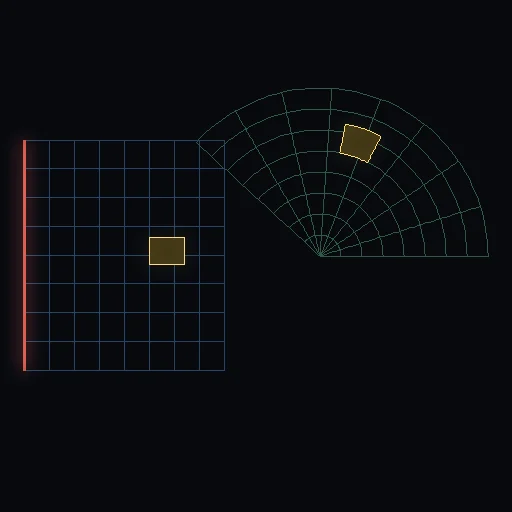
Change variables in an integral and a factor appears; everyone learns to write r dr dθ and few are shown where the r comes from. It is the determinant of the map's derivative - the ratio between a tiny cell's area and its image's, measured here on the polygons themselves. Three things that determinant is not: the sign is an orientation and not part of the factor, a vanishing determinant means an edge collapsed rather than cells got small, and the integral of |det J| equals the image's area only when the map covers it once. z → z² covers the unit disc twice and the total is out by exactly two.

Bounds instead of estimates — Actual application image

Math

Bounds instead of estimates

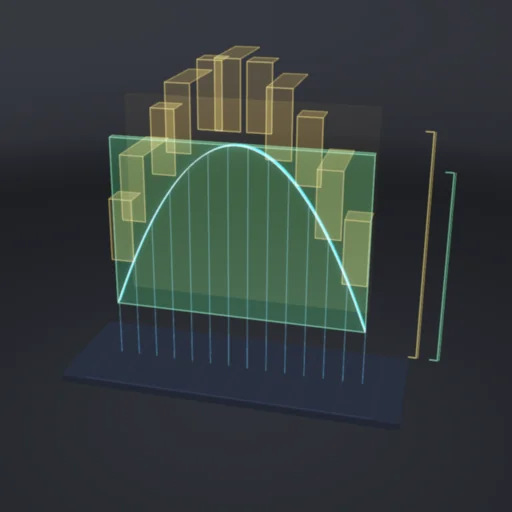
Every other way of computing gives a number that is probably right. Interval arithmetic gives a pair that is certainly right, and the whole subject is what that costs. It costs sharpness, and the cost has a name: every occurrence of a variable is treated as a different variable, so x − x comes out as an interval two units wide. Which means the enclosure is a property of the FORMULA, not of the function - rewrite x(1 − x) as 0.25 − (x − 0.5)² and the width falls from 1 to the true 0.25; write x·x instead of x² in 1/(1 + 25x²) and the answer becomes the entire real line.

Slicing a surface — Actual application image

Math

Slicing a surface

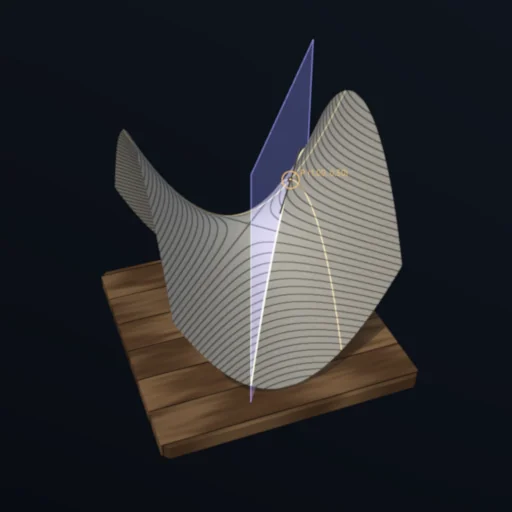
Cut a surface with a vertical plane and you get a curve; its slope is the derivative in that direction. Turn the plane and watch the slope change, then plot it in polar coordinates: for a differentiable surface that plot is exactly a circle with the gradient as its diameter, so the gradient being the steepest way up stops being a claim and becomes a picture. And one surface here has both partial derivatives, a directional derivative in every direction, and no tangent plane at all - the formula ∇f·u predicts zero while the surface climbs at 0.385, because existing is a weaker thing than differentiable.