Earth
The rock cycle
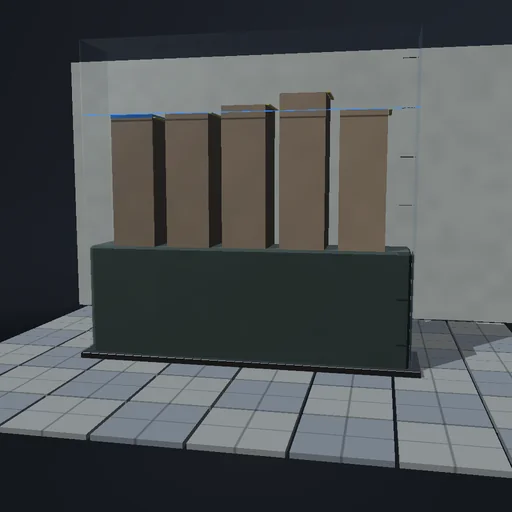
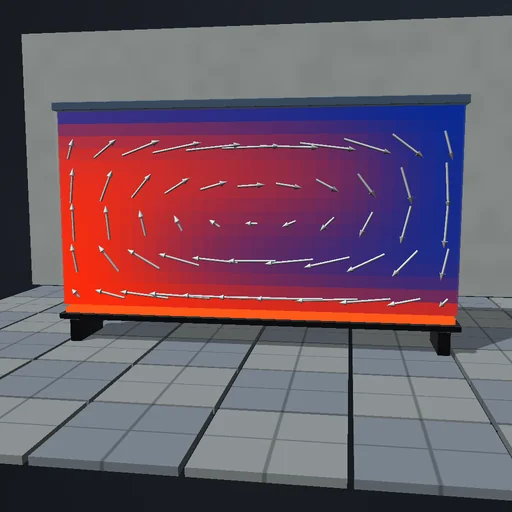
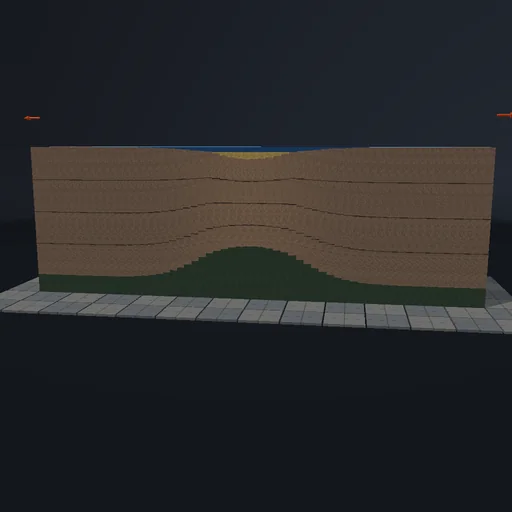
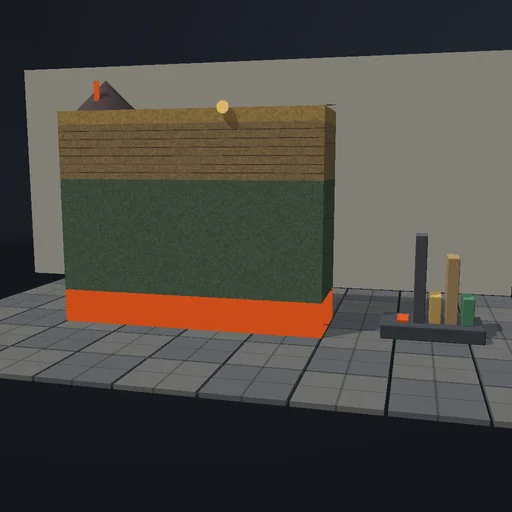
Bury a grain of sediment and watch it lithify at 2 km, turn metamorphic at 300 °C and begin to melt at 700 °C; exhume the melt and it crystallizes, rises and weathers back to sediment at the surface. Beside it five reservoirs trade mass at set rates: the total never changes, each has its residence time, and after a few hundred million years they settle at the proportions the rates dictate.
What happens
Five reservoirs - magma, igneous, sediment, sedimentary and metamorphic rock - exchange mass by first-order fluxes: crystallization, weathering, lithification, metamorphism and melting. The total is conserved exactly, the steady state is the null vector of the rate matrix and each reservoir’s residence time is the inverse of its outgoing rate; RK4 in 0.01 Myr steps. Beside them a sample is buried or exhumed along a 25 K/km geotherm and changes type at explicit thresholds: lithification at 2 km and 60 °C, metamorphism at 10 km and 300 °C after 2 Myr in its type, melting at 700 °C, crystallization below it, weathering to sediment after 1 Myr at the surface.
Try this
Bury the grain and read the depths of each transition against the geotherm; exhume it and watch it crystallize, metamorphose and weather. Let the reservoirs run for a few hundred Myr and compare them with the steady state.
The model and its limits
First-order fluxes with constant rates, a linear geotherm, type changes at fixed thresholds; the sample’s path is kinematic. A teaching cycle, not a geochemical budget.
Equations used in the module
Equations
dM/dt = A·M,  Σ M = const
A·M_∞ = 0,  τ_i = 1/|A_ii|
T = T_0 + Γ·z
f_melt = (T − 700)/300