MakarovSuites
English
EnglishDeutschРусскийУкраїнськаFrançaisEspañolItalianoPolski
Contact & licences

Physics

Why a bicycle stays up

Explore self-stability in the linear Whipple bicycle benchmark. Speed, trail, steering-axis tilt and wheel gyroscopic terms change the freely evolving lean and steer response.
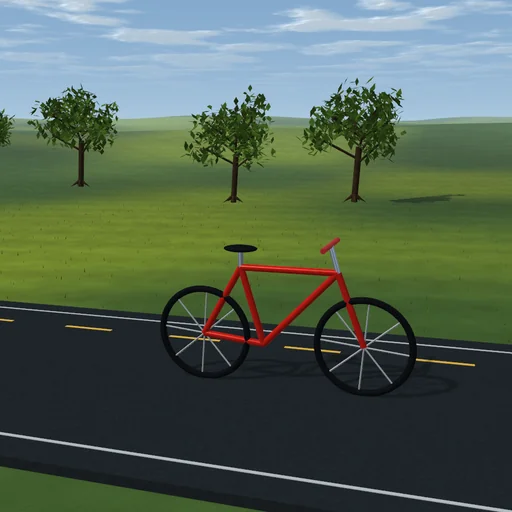
Why a bicycle stays up — Actual application image
Actual application image

Try this

Change speed, trail and steering tilt. The linear Whipple model applies near upright with a rigid rider mass. Beyond 35°, the scene switches to an illustrative rigid-body fall with road contacts; the small-angle calculation has ended.

Equations used in the module
Equations
M q″ + v C1 q′ + (g K0 + v² K2) q = 0
q = (lean, steer)
Meijaard benchmark: w = 1.02 m; trail = 0.08 m; tilt = π/10
Related experiments

Back to catalogue
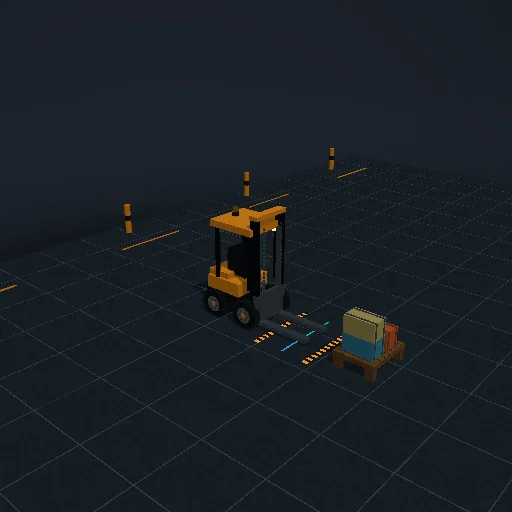
Forklift warehouse — Actual application image

Physics / Engineering

Forklift warehouse

Drive a forklift and transport pallets with loose crates that interact through contact and friction.

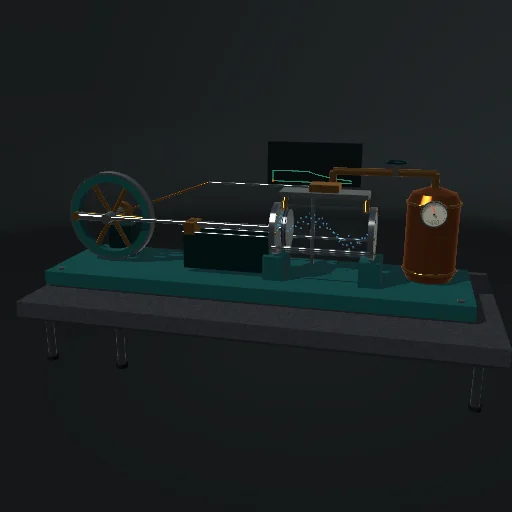
Steam engine — Actual application image

Physics / Engineering

Steam engine

An ideal double-acting steam engine couples admission and expansion to a slider-crank and loaded flywheel. Change boiler pressure and cut-off while inspecting the indicator diagram.

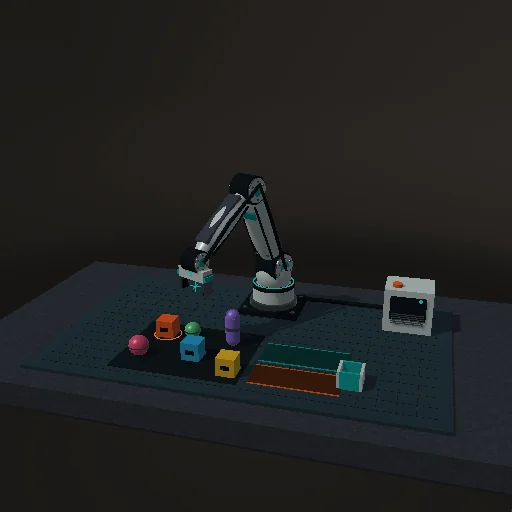
Robot arm workshop — Actual application image

Physics / Engineering

Robot arm workshop

Control a six-axis robot arm, grasp physical objects, sort a mixed batch or build a tower. Explore inverse kinematics, joint limits and payload with the suite’s 3D contact solver.