Math
4D polytopes
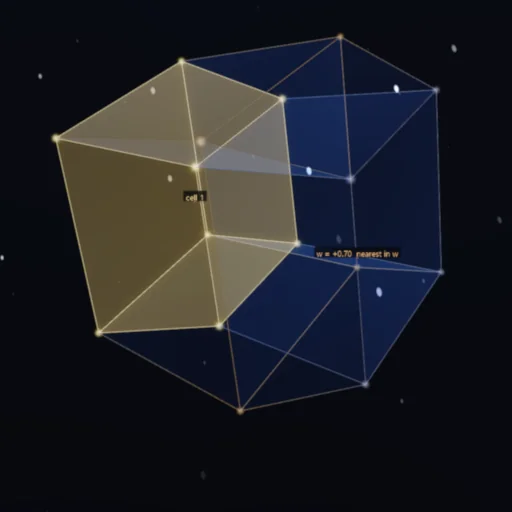
The tesseract, the 24-cell and the 600-cell, rotated in four dimensions and projected into three.
What happens
The shadow of a tesseract is a cube inside a cube. Turn the object in the xw plane - through the fourth dimension - and the inner cube swells, passes through the outer one and takes its place: that breathing is the fourth dimension, seen. Six regular convex 4-polytopes exist and this is all of them, built from coordinates and counted, with Euler's V − E + F − C = 0 holding for each. The 120-cell is not typed in: it is the 600-cell turned inside out, its 600 vertices the centres of the other's 600 tetrahedra. Edges are coloured by their w - warm near the 4D eye, cold far from it - and one cell at a time is lit gold and walks across the polytope, so a 600-cell reads as six hundred tetrahedra rather than as a ball of lines. Right-drag turns the object in 4D by hand.
Equations used in the module
Equations
V − E + F − C = 0   (Euler, any convex 4-polytope)
x′ = x cos θ − w sin θ,   w′ = x sin θ + w cos θ   (a turn in the xw plane)
(x, y, z)₃ = (x, y, z)·D / (D − w)   (perspective from a 4D eye at w = D)
{p, q, r}: p-gons, q round an edge, r round a vertex... in 4D