Math
Platonic and Archimedean solids
Five perfect solids, their truncations and their duals: cut the corners and the football appears.
What happens
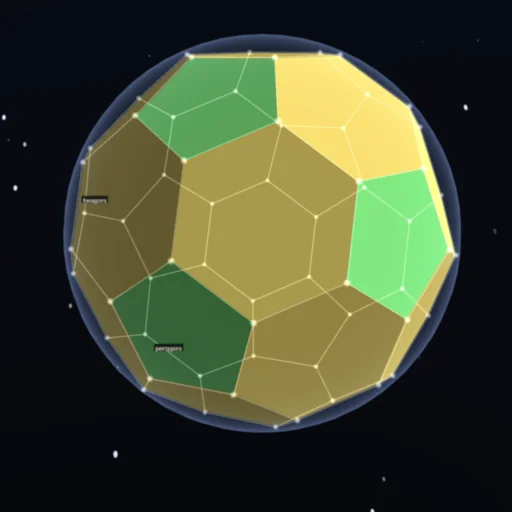
There are five convex solids with every face the same regular polygon and every corner alike, and no sixth. Cut the corners off one - each edge gives up a fraction t at either end - and the corner faces grow while the old faces shrink; at one particular t the new faces come out regular, every edge is the same length, and the solid is Archimedean: the truncated icosahedron at t = 1/3 is the football, twelve pentagons and twenty hexagons. Go on to t = 1/2 and the old faces meet at their midpoints: the rectification, cuboctahedron or icosidodecahedron. Here the cutting runs by itself and pauses where the cuts are regular. Every face is coloured by its number of sides, the census on the panel is counted from the picture, and V − E + F = 2 at every t. The dual - a vertex for every face - can be lit inside.
Equations used in the module
Equations
V − E + F = 2   (Euler, any convex polyhedron)
truncation: every edge (i, j) gives the point v_i + t (v_j − v_i);  t = 0 Platonic, t = 1/2 rectified
t* = 1 / (2 + 2 sin(α/2)),  α the face angle: 1/3 for triangles, 0.2929 for squares, 0.2764 for pentagons
at t* the cut faces are regular and every edge is equal: Archimedean
dual: one vertex per face, one edge per pair of faces that share an edge