Games
Backgammon and nardy
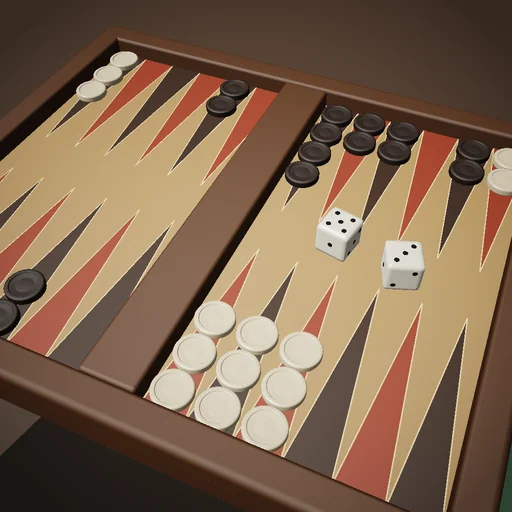
Long nardy, the game of the Caucasus and Central Asia, and short nardy, known in the West as backgammon, on a walnut board with ivory and ebony checkers and dice that tumble to rest. Every legal way to play a roll is offered step by step; the computer judges positions with the small neural networks of 3D Nardy, taught by playing itself, at five levels from a novice that misjudges on purpose to a master that looks a roll ahead. Play the computer, a friend at the same table, or watch a demo game.
What happens
Long nardy: each player starts with fifteen checkers on the head, and both run the same way round the board to their home and off. A single checker holds a point; only one checker may leave the head a turn, two on a first roll of 6-6, 4-4 or 3-3; no six points in a row may be held unless an opponent’s checker is already past them. A win is one point, two for a mars when the opponent has borne off none. Short nardy (backgammon): the players run toward each other; a lone checker is hit to the bar and must enter the opponent’s home before anything else moves; a win is one point, two for a mars (gammon), three for a koks (backgammon). In both games a double is played four times, both dice must be played when they can be, the higher one when only one can, and the checkers are borne off once all fifteen are home. The computer judges every way of playing a roll by the position it leaves: a network of 200 inputs, 64 hidden units and three outputs – the chances of winning, of winning a mars and of losing one – taught by temporal-difference learning over a million games of each kind; the master also weighs every roll the opponent may answer with.
Try this
Click a checker, then where it goes; a quick second click on it plays the higher die. Roll with the button or a click on the board. Turn the table with the right mouse button, zoom with the wheel.