Engineering
Cargo drone delivery
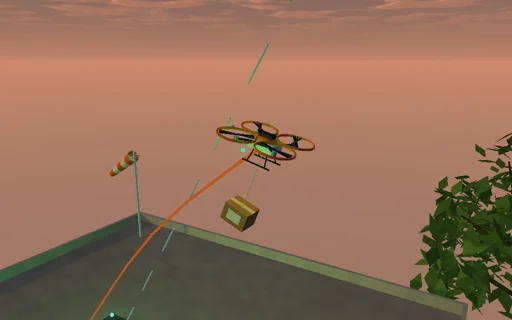
Fly a parcel down a suburban street on a summer evening: a quadcopter lifts off the depot’s rooftop pad, crosses the gardens into a gusty headwind, brakes over the last house, lowers the parcel on its winch onto the delivery mat and flies home. Each rotor needs the momentum-theory power T^1.5/sqrt(2ρA) in hover; in forward flight the induced power falls, the blade and body drag rise, and the closed-form power curve gives the best-endurance and best-range speeds. Brake sharply and the parcel swings like a pendulum of period 2π sqrt(L/g); switch on anti-sway and the controller follows the swing until it dies. Hold the drone in a steady wind and it is in forward flight through the air - its tilt, the parcel’s trail angle and the power equal their closed forms - and every joule drawn from the battery is followed into the rotors’ wake, the blades, the drag, the height and the winch.
What happens
A 2.6 kg quadcopter with four rotors of 0.19 m radius carries a 1 kg parcel in the vertical plane of the gardens (x, height, pitch). Each rotor of thrust T needs the induced power κ·T·v_i with κ = 1.15 and Glauert’s level-flight inflow v_i² = v_h^4/(V²/2 + sqrt(V^4/4 + v_h^4)), v_h² = T/(2ρA) - in hover T^1.5/sqrt(2ρA), 50.3 W ideal per rotor - plus the profile power (σ·Cd0/8)·ρ·A·(ΩR)³·(1 + 4.65μ²) with σ = 0.08, Cd0 = 0.012 at the tip speed its thrust needs (C_T = 0.008, about 90 m/s); the rest of the shaft power is the thrust’s own work through the air. Body and parcel drag ½ρ·f·V² with 0.035 and 0.045 m². The closed-form level-flight curve P(V), T = sqrt(W² + D²), gives 279 W in hover, the best-endurance speed 8.7 m/s and the best-range speed 13.1 m/s. The controller: a route profile braking at the set deceleration, a PI velocity loop, the measured tether pull fed forward, the thrust vector limited to 29° of tilt, a PD attitude loop at 20 rad/s, the rotor split within 0.5–22 N; anti-sway leans the velocity reference toward the parcel’s swing, and aiming holds the drone upwind by the parcel’s steady trail. The parcel hangs on a one-sided tether held by its exact constraint force with Baumgarte stabilization; the winch pays out at 0.7 m/s over the mat, the hook lets go at touchdown, located inside the step. Forces are held over 2 ms sub-steps with Euler velocities and trapezoid positions, so each force’s work is exactly F·dx: battery = motor heat (78 % efficiency) + induced + profile + parasite + height + motion + winch brake − wind exchange + touchdowns, to round-off. Battery 22.2 V, 5 Ah, 20 % reserve.
Try this
Watch the delivery and read the hover power and the two best speeds; switch to Hover, set a tether length and an initial swing and compare the period with 2π sqrt(L/g); switch anti-sway off and brake sharply; raise the wind and the gusts and watch the hold and landing errors and the battery.
The model and its limits
A planar quadcopter (x, height, pitch) with momentum-theory rotors: Glauert’s level-flight inflow from the whole airspeed, no vortex-ring state, no rotor inertia or motor lag, profile drag from one blade drag coefficient; a point parcel on an inextensible one-sided tether fixed at the centre of mass; uniform wind with two-sine gusts, no wakes off houses or trees; the battery as an energy store at constant efficiency, without voltage sag or Peukert effect. One street at full scale; a real delivery route is kilometres long, so the range reading extrapolates the power curve.
Equations used in the module
Equations
P_i = κ·T·v_i,  v_i² = v_h^4/(V²/2 + √(V^4/4 + v_h^4)),  v_h² = T/(2ρA),  hover: P = T^1.5/√(2ρA)
P(V) = κ·T·v_i + 4·(σ·C_d0/8)·ρ·A·(ΩR)³·(1 + 4.65·μ²) + D·V,  T = √(W² + D²),  D = ½·ρ·f·V²
L·d²φ/dt² = −g·sin φ − a_n,  T_0 = 2π·√(L/g)·(1 + φ0²/16),  tan φ_wind = D_p/(m_p·g)
E_batt = Q_motor + W_i + W_0 + W_par + ΔE_k + ΔE_p + W_brake − W_wind + E_touch