Engineering
Hovercraft
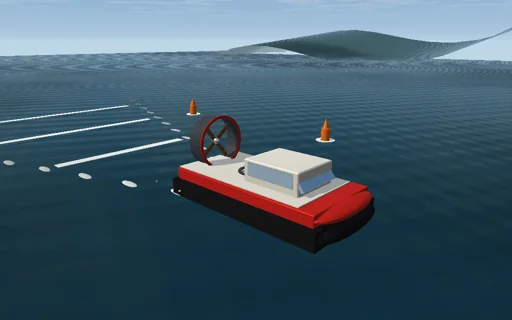
Start the lift fan and watch the craft rise off its skirt until the cushion carries its weight and the air escapes through a gap of a few centimetres, exactly where the fan’s curve meets the leakage. Open the throttle over the sea: the craft’s own waves drag hardest at the hump near sqrt(gL/pi), where the wake is one craft length long - a weak propeller stays stuck below it at the closed-form speed, a strong one breaks through and runs to its top speed. Try the beach, where there are no waves; slow the fan until the cushion can no longer lift the craft off its skirt.
What happens
An 1800 kg craft, 6 by 3 m, with a 0.6 m skirt. The lift fan follows a parabolic curve, 2 kPa at shut-off and 15 m³/s at zero pressure; the cushion is compressible and leaks through the hover gap at C_d·perimeter·gap·sqrt(2p/rho), so the craft settles where the fan’s flow equals the leak at the pressure m g / A. The ducted propeller gives 3 kN falling with speed against air drag and, over the sea, the wave resistance of the moving pressure patch with smoothed skirt edges; its hump lies near sqrt(g L / pi). On the beach the skirt scuffs the sand instead. RK4 at 1 ms; heave and surge work are booked with the same weights.
Try this
Let the craft lift off and compare the gap with the closed form; open the throttle over the sea and watch the speed hang at the hump or break through; try the beach; slow the fan until the craft sits on its skirt.
The model and its limits
A rigid craft in heave and surge only, a two-dimensional wave-drag patch, a single cushion without trim or skirt dynamics, calm water. Speeds and gaps are those of this idealized craft.
Equations used in the module
Equations
Q_fan = Q0·√(1 − p/p0),  Q_leak = C_d·L_p·h·√(2p/ρ) + ε·p
dp/dt = γ·p_a/V_c·(Q_fan − Q_leak − A·w),  m·a_z = p·A − m·g + N_skirt
D_w = (2p²B/(ρ_w·g))·(1 − cos kL)·e^(−(kσ)²),  k = g/V²
m·a_x = T0·(1 − V/V_p) − ½·ρ·C_D·A·V² − D_w,  V_hump = √(g·L/π)